


How to Build a Diversified Portfolio with Fractional Property Investment in UAE

Learn how to build a diversified UAE property portfolio using fractional investing—mix locations, asset types, and risk profiles while managing fees and exits.


KEY takeaways
How to Build a Diversified Portfolio with Fractional Property Investment in UAE
Building a real-estate portfolio in the UAE no longer requires a huge down payment. With fractional ownership real estate UAE options and property crowdfunding UAE platforms, you can buy small shares in multiple properties and get income and exit proceeds in proportion to your stake. Think of it like creating an index of buildings instead of betting everything on one apartment.
Because minimum tickets are low, you can spread money across cities, communities, and asset types—residential long-let, short-stay, logistics, even select hospitality—without overcommitting to a single deal. This helps smooth out vacancies, seasonality, and market swings.
The UAE is set up for this approach. Dubai Land Department (DLD) handles title and escrow for off-plan. Financial regulators in DIFC, onshore UAE, and ADGM have clear rules for licensed platforms. Dubai’s tokenisation pilots are also pointing to faster, more transparent co-ownership.
This guide shows how to use fractional property investment to diversify with intent: what to check about regulation and fees, how to mix locations and yield profiles, and simple sample allocations you can copy and adapt.
Why This Matters
Real estate is changing fast. In the UAE—especially Dubai—rules are clear, the economy is strong, and investor demand stays high. That makes it a good place to spread risk instead of betting on one big property.
The access problem (solved):
Traditional property buys need large down payments and big mortgages. Fractional ownership fixes that. With fractional ownership real estate UAE and property crowdfunding UAE platforms, you can buy a small share of high-quality assets and still earn your pro-rata income and gains.
Proof the market is active:
- Dubai logged 84,196 property deals worth AED 300B in 2021—a record year.
- Both ready homes and off-plan units sold well, showing depth on day-one income and future growth.
These numbers show a market with scale, liquidity, and ongoing interest.
Why fractional is timely
- Lower entry ticket: Start with hundreds or low thousands of dirhams, not millions.
- Built-in diversification: Spread across cities, communities, and asset types.
- Less hassle: Platforms handle tenants, service charges, and reporting.
- Flexible exits: Some offer secondary markets or planned sell-downs.
- Inflation hedge: Rents and asset values can help protect purchasing power.
Bottom line:
Fractional property lets you join a large, active market with smaller amounts, less admin, and better diversification. It’s a practical path to long-term growth without the stress of sole ownership.
Understanding Fractional Property Investment
Fractional property investment is an innovative approach that allows multiple investors to collectively own a single high-value property. Instead of purchasing an entire property, investors buy 'fractions' or shares of it. This model significantly lowers the entry barrier to the lucrative real estate market, making it accessible to a wider range of investors. In the UAE, this concept has gained considerable traction, especially in prime locations like Dubai, where property values can be substantial.
How it Works:
- Co-ownership: Multiple individuals or entities become co-owners of a single property.
- Digital Platforms: Investments are typically facilitated through specialized digital platforms that manage the acquisition, ownership, and management of the property.
- Share-based Ownership: Each investor owns a percentage or a specific number of shares in the property, proportionate to their investment.
- Rental Income & Appreciation: Investors receive a share of the rental income generated by the property and benefit from any capital appreciation when the property is eventually sold.
- Professional Management: The property is usually managed by a professional entity, handling maintenance, tenant relations, and other operational aspects, freeing investors from day-to-day responsibilities.
The Four Pillars of Fractional Real Estate Diversification
True diversification in real estate is about more than just owning multiple properties. It’s about strategically spreading your investments across different risk factors. Here are the four pillars you need to consider:
1. Geographic Diversification: Beyond a Single City

Spreading your investments across different locations is a fundamental risk management strategy. A downturn in one city or neighborhood may not affect another. Fractional ownership makes this easier than ever.
Strategy in Action: Instead of investing AED 200,000 into a single apartment in Dubai Marina, a portfolio builder could allocate:
- AED 50,000 in a high-yield apartment in Dubai's Jumeirah Village Circle (JVC).
- AED 50,000 in a luxury waterfront property on Abu Dhabi's Yas Island.
- AED 50,000 in an emerging-market villa in Ras Al Khaimah.
- AED 50,000 in a commercial property in Dubai's Business Bay.
This instantly diversifies your portfolio across different emirates and market segments, protecting you from localized risks.
2. Property Type Diversification: A Mix of Asset Classes

Different property types perform differently depending on the economic cycle. A well-diversified portfolio should include a mix of asset classes to ensure stable returns.
Asset Classes Available Through Fractional Ownership:
- Residential: Apartments and villas offer steady rental demand and are relatively low-risk.
- Commercial: Office spaces and retail units provide longer lease terms and potentially higher returns, but are more sensitive to economic conditions.
- Hospitality: Hotel apartments can offer high yields, but are tied to the tourism industry.
- Industrial & Logistics: Warehouses and logistics centers are booming due to the growth of e-commerce.
- Alternative Assets: Niche sectors like data centers and cold storage are showing impressive growth, with one report noting they have delivered 11.6% annual returns over the past decade, compared to 6.2% for traditional properties.
By combining these asset types, you can create a portfolio that generates consistent income and is resilient to sector-specific downturns.
3. Platform Diversification: Don’t Put All Your Eggs in One Basket
While regulated platforms are secure, it’s wise to spread your investments across multiple platforms to mitigate platform-specific risk. Different platforms also offer access to different types of properties and investment structures.
Top Regulated Platforms in the UAE:

Using multiple platforms gives you access to a wider deal flow and protects your portfolio from any single platform’s operational issues.
4. Capital Stack Diversification: Equity vs. Debt

This is a more advanced strategy. The "capital stack" refers to the different layers of financing for a real estate project. While most fractional platforms offer equity investments (direct ownership), some are beginning to offer debt-based products, such as a share in the loan provided to a property developer.
- Equity: Higher risk, higher potential return (from both rent and appreciation).
- Debt: Lower risk, fixed returns (interest payments).
Including a mix of both can help you balance the risk-return profile of your real estate portfolio.
Benefits of Fractional Property Ownership in the UAE
Fractional ownership offers a compelling set of advantages, particularly in a dynamic market like the UAE. These benefits address many of the traditional challenges associated with real estate investment.
1. Accessibility and Affordability:

One of the most significant benefits is the reduced financial commitment. Investors can enter the Dubai property market with investments starting as low as AED 500 (approximately USD 136) on some platforms. This contrasts sharply with the millions often required for outright property purchases, democratizing access to high-end real estate.
2. Diversification of Investment Portfolio:

Fractional ownership allows investors to diversify their portfolios across multiple properties and property types (residential, commercial, hospitality) without tying up large amounts of capital in a single asset. This diversification strategy helps mitigate risk, as the performance of one property does not solely dictate the overall portfolio's health.
3. Access to Premium Properties:

With fractional ownership, investors can gain access to prime properties in sought-after locations that would otherwise be out of reach. This includes luxury apartments, commercial spaces, and even hotel properties, offering exposure to higher potential returns and prestige.
4. Passive Income Generation:

Investors receive a regular share of the rental income, providing a steady stream of passive income. The professional management handles all aspects of tenancy, ensuring a hassle-free experience for investors.
5. Reduced Hassle and Management:

Unlike traditional property ownership, fractional investors are not burdened with property management responsibilities. The platform or a designated management company takes care of maintenance, tenant sourcing, legal compliance, and other operational tasks.
6. Potential for Capital Appreciation:

The UAE property market has historically shown strong capital appreciation. Fractional owners benefit directly from the increase in the property's value over time, realizing gains upon the sale of their shares or the entire property.
7. Liquidity (Emerging):

While real estate is traditionally illiquid, some fractional ownership platforms are exploring or offering secondary markets for shares, potentially increasing the liquidity of these investments.
The UAE Regulatory Map (what protects you)
- DFSA (DIFC): Sets detailed rules for Property Investment Crowdfunding—platform disclosures, valuation reports, SPV use, investment limits, and that listed properties meet specific criteria (e.g., restrictions on mortgaged or jointly owned assets). [Source: DFSA COB 11.6, 2025].
- SCA (onshore UAE): Cabinet Resolution 36/2022: you need a license to operate a crowdfunding platform in the State (outside financial free zones). [Source: SCA, 2024 update of Resolution PDF].
- ADGM FSRA (Abu Dhabi): Private Financing Platform (PFP) rules and Private Capital Markets guidance create a path for alternative financing and secondary trading within ADGM. [Source: FSRA Guidance, 2023; PFP rules].
- DLD (Dubai): Governs title deeds, transfers, and escrow for off-plan (Law No. 8 of 2007). In 2025, DLD launched a real-estate tokenisation pilot to enable compliant fractional participation through linked registries. [Source: DLD law & tokenisation news].
- VAT (FTA/MoF): Residential first supply (developer to first buyer within 3 years) is zero-rated; resales/long-term leases are typically exempt; commercial property sales/leases are 5% VAT. Platform/service fees may include VAT. [Source: MoF/FTA].
Quick check: Always verify who regulates the platform (DFSA, SCA, or FSRA) and how your ownership is recorded (SPV shares vs. co-title/token).
Building Your Diversified Portfolio: A Step-by-Step Guide
Here is a practical framework for constructing your diversified fractional real estate portfolio.
Step 1: Define Your Investor Profile

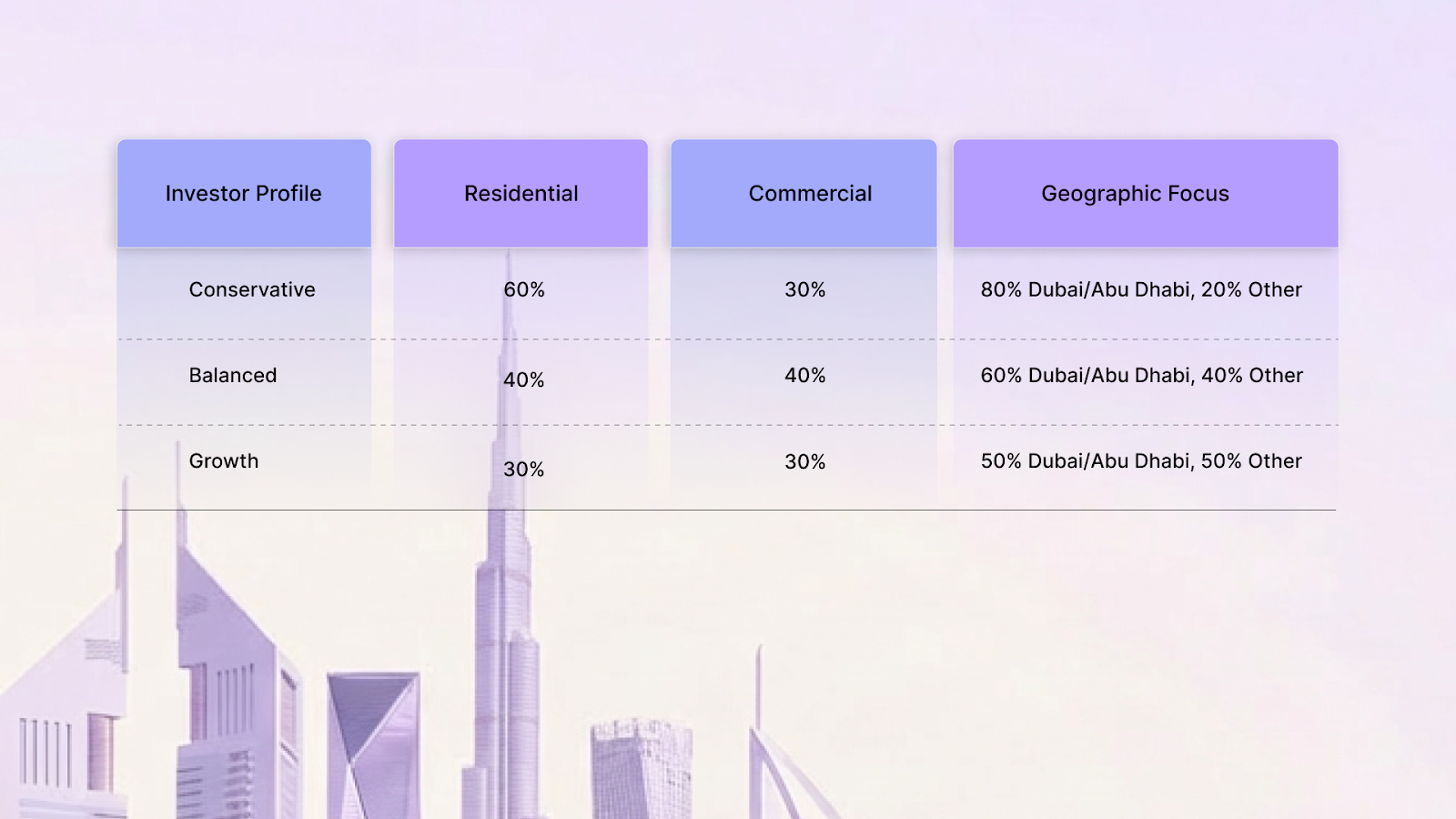
First, determine your risk tolerance. Are you a conservative, balanced, or growth-oriented investor?
- Conservative: Prioritizes capital preservation and stable income. Focus on prime residential properties in established areas.
- Balanced: Seeks a mix of income and growth. A combination of residential, commercial, and some alternative assets.
- Growth: Aims for maximum capital appreciation. Higher allocation to alternative assets, off-plan developments, and emerging locations.
Step 2: Create Your Asset Allocation Model
Based on your profile, create a target asset allocation. Here are some sample models:
Step 3: Start Investing and Reinvest Returns

Begin by making small investments across your target asset classes and locations. As you receive monthly rental income, reinvest it to buy more fractions. This harnesses the power of compounding to accelerate your portfolio’s growth.
Step 4: Monitor and Rebalance Annually

At least once a year, review your portfolio’s performance. Some investments may have grown faster than others, shifting your asset allocation. Rebalance by selling some of your outperforming assets and reinvesting in under-allocated areas to maintain your desired risk profile.
Choosing the Right Fractional Investment Platform
Due Diligence: A 10-minute Pre-Check
- License & regulator: DFSA register (DIFC) or SCA authorization (onshore); for ADGM, check FSRA. Keep a screenshot. [Sources: DFSA, SCA, FSRA].
- What you own: SPV shares vs. DLD co-title vs. tokenised certificate—how do distributions flow? [Source: DLD tokenisation, 2025].
- Valuation & reports: Who valued the asset? Is there a current tenancy and service-charge budget? [Source: DFSA COB 11.6].
- Fees: Entry + annual + performance + exit. Model a net yield case.
- Exit rules: Secondary market? Fixed hold with vote to sell? Token transfer rules?
- Off-plan only: Confirm escrow details and milestone release rules. [Source: Law No. 8 of 2007].
- VAT & tax: Check VAT on platform fees and whether the asset is commercial or residential. [Source: MoF/FTA].
Risk Controls (for portfolio builders)
- Vacancy risk: Spread across buildings and tenant types.
- Fee drag: Favour transparent, all-in fee tables; compare two platforms for the same yield.
- Leverage risk: Many DFSA property crowdfunding offers restrict mortgaged assets—understand the rule intent. [Source: DFSA COB 11.6].
- Liquidity: Treat secondaries as helpful, not guaranteed. Set hold horizons per deal.
- Concentration: Cap any single asset at 10–20% of your total fractional pot.
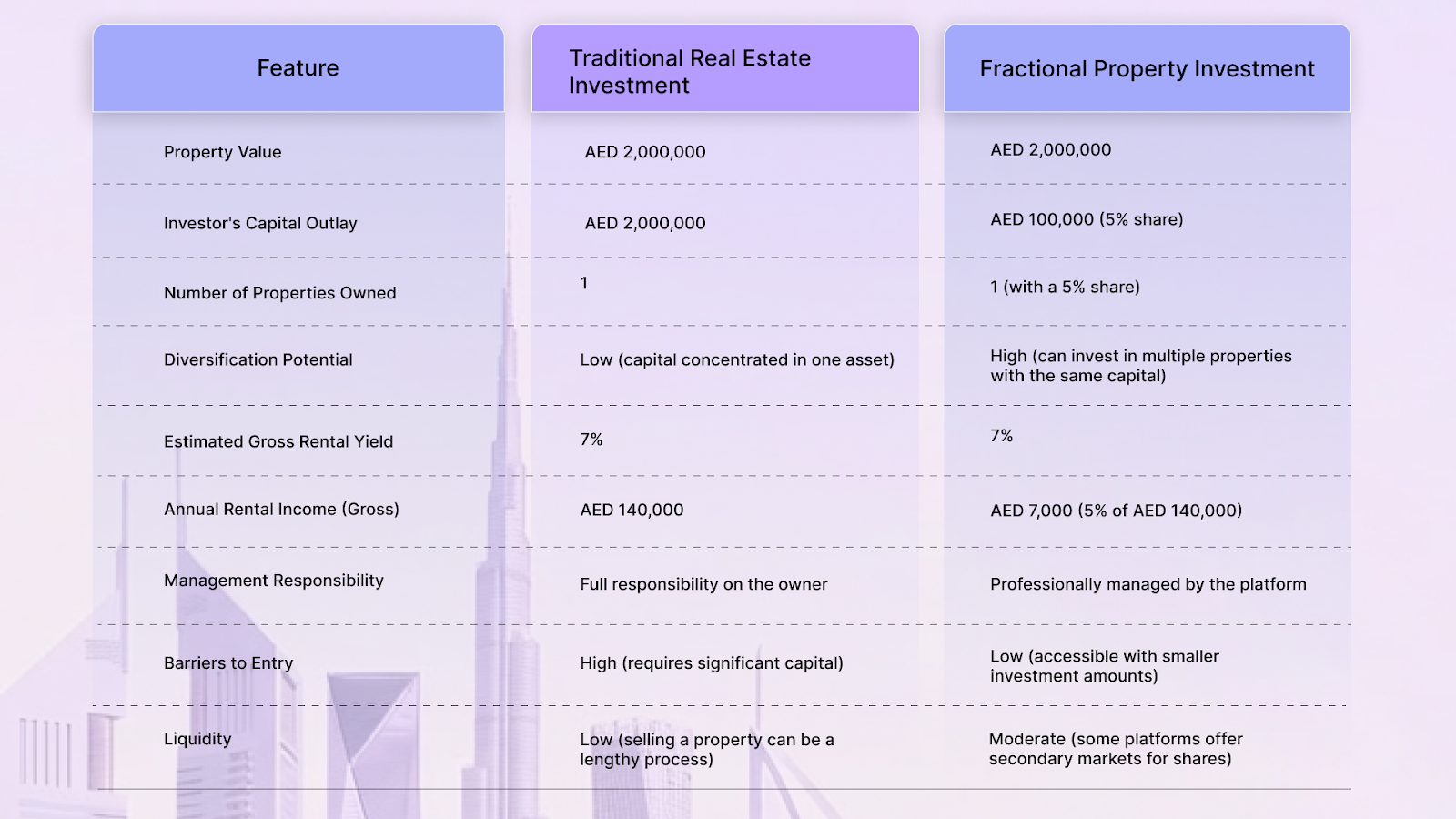
Data Insight Box: Fractional vs. Traditional Real Estate Investment in the UAE
To provide a clearer perspective on the financial implications of fractional versus traditional property investment in the UAE, we've compiled a comparative data table. This table uses hypothetical yet realistic figures based on current market trends to illustrate the differences in capital outlay, potential returns, and diversification opportunities.
Takeaways:
- Capital Efficiency: Fractional investment allows for a much lower capital outlay, freeing up funds for other investments and enhancing portfolio diversification.
- Diversification: With the same capital required for a down payment on a single traditional property, an investor could potentially acquire shares in multiple fractional properties, spreading risk and increasing exposure to different market segments.
- Passive Investment: Fractional ownership offers a truly passive investment experience, with professional management handling all operational aspects. This is a significant advantage for investors who lack the time or expertise for active property management.
- Comparable Returns: While the absolute rental income is lower due to the smaller investment size, the percentage-based returns (rental yield and potential capital appreciation) are comparable to those of traditional ownership, making it an attractive proposition for generating passive income and long-term growth.
FAQ Section
Q1: What is the minimum investment required for fractional property ownership in the UAE?
A1: The minimum investment can vary by platform, but some reputable platforms in the UAE allow investors to start with as little as AED 500 (approximately USD 136). This significantly lowers the barrier to entry compared to traditional property purchases, making real estate investment more accessible to a broader range of individuals.
Q2: Is fractional property ownership legal in Dubai?
A2: Yes, fractional property ownership is legal and regulated in Dubai. The Dubai Land Department (DLD) has introduced initiatives like the Fractional Title Deed, which legally recognizes co-ownership of properties. It's crucial to invest through platforms that are licensed and compliant with DLD regulations to ensure legal security.
Q3: How do I earn returns from fractional property investment?
A3: Investors typically earn returns in two ways: through rental income and capital appreciation. You receive a proportional share of the rental income generated by the property, providing passive cash flow. Additionally, if the property's value increases over time, you benefit from capital gains when your shares or the entire property are sold.
Q4: What are the risks associated with fractional property investment?
A4: While offering many benefits, risks include potential illiquidity of shares (though some platforms offer secondary markets), ongoing management fees that can impact returns, and market fluctuations affecting property values. It's essential to conduct thorough due diligence on the platform and the specific property before investing.
Q5: How does fractional ownership differ from REITs (Real Estate Investment Trusts)?
A5: Fractional ownership involves direct co-ownership of a specific physical property, giving you a tangible asset. REITs, on the other hand, are companies that own, operate, or finance income-generating real estate. When you invest in a REIT, you're buying shares in the company, not directly in the properties themselves. Fractional ownership often provides more direct control and transparency over the specific asset.
Q6: Can foreign investors participate in fractional property ownership in the UAE?
A6: Yes, foreign investors can generally participate in fractional property ownership in the UAE, particularly in designated freehold areas. The UAE actively encourages foreign investment in its real estate sector. However, it's always advisable to check the specific platform's policies and any country-specific regulations that might apply to international investors.
Q7: What kind of properties are typically available for fractional investment?
A7: Fractional investment platforms in the UAE offer a range of properties, including luxury residential apartments, villas, and commercial spaces. Some platforms also include hotel rooms or serviced apartments, allowing investors to tap into the hospitality sector. The selection often focuses on high-value properties in prime locations with strong rental yield potential.
Deed's Take
At Deed, we built our platform with the portfolio builder in mind. We understand that diversification is not just a buzzword; it's the cornerstone of intelligent investing. Our approach is to provide the tools and access needed to construct a truly diversified portfolio with ease and precision.
We believe that by lowering the barrier to entry and offering a wide range of vetted properties, we empower investors to move beyond theory and put these diversification strategies into practice. Our commitment to DFSA regulation and transparency provides the secure foundation needed to build a long-term, resilient real estate portfolio.
How Deed Helps You Diversify
Deed is uniquely positioned to help you execute your diversification strategy:
- Micro-Investments for Macro-Diversification: With a minimum investment of just AED 500, you can spread your capital across dozens of properties, achieving a level of diversification that was previously impossible.
- Curated Deal Flow: We offer a curated selection of high-quality residential and commercial properties, giving you access to different asset classes from a single platform.
- Effortless Management: Our platform handles all the complexities of ownership, allowing you to focus on your high-level portfolio strategy.
- Transparent Performance Tracking: Our app provides real-time data on your rental income and portfolio value, making it easy to monitor your investments and rebalance when needed.
Conclusion & Call to Action
Building a diversified investment portfolio is a cornerstone of sound financial planning, and fractional property investment in the UAE offers a powerful, accessible avenue to achieve this. By democratizing access to high-value real estate, this innovative model allows investors to mitigate risk, generate passive income, and benefit from the robust growth of the UAE property market without the traditional burdens of full ownership.
Embrace the future of real estate investment. Explore reputable fractional ownership platforms in the UAE today and take the first step towards building a more resilient and diversified portfolio. Your journey to smart, accessible property investment starts now.
__________________________________________________
For promotional purposes only. Property and other details may vary. Capital at risk. Deed is regulated by the DFSA.
Senior Growth, Marketing & Brand Manager | Elevating Brand Equity & Fueling Sales Growth Across Fintech, Proptech.
Signup to our newsletter!
Stay ahead with exclusive updates, insights, and opportunities delivered straight to your inbox.
Frequently Asked Questions

Start earning passive income today
Join thousands of investors building wealth through fully-managed rental properties.