


How to Navigate Dubai Property Investment Tax Implications: Complete Tax Guide

Understand Dubai property taxes, VAT, corporate tax rules, DLD fees, and Golden Visa benefits to invest smartly and maximize tax-efficient returns.


KEY takeaways
How to Navigate Dubai Property Investment Tax Implications: Complete Tax Guide
Dubai’s tax regime is a big part of its real-estate appeal. But “low tax” does not mean “no rules.” Between corporate tax for businesses, VAT nuances, municipal charges, DLD transfer and mortgage fees, and tourism taxes for short-stays, it’s easy to miss something that erodes your return—or triggers avoidable admin.
This comprehensive guide provides tax-conscious investors with essential knowledge about Dubai property investment tax implications. Learn about the UAE's tax-free environment, understand VAT applications, navigate corporate tax rules, and discover compliance requirements.
From Golden Visa benefits to the latest 2025 tax updates, this guide covers everything you need to make informed investment decisions while maximizing your tax advantages in Dubai's dynamic real estate market.
Why Understanding Tax Implications Matters
For tax-conscious investors, understanding the complete tax landscape is the difference between a good investment and a great one. Dubai's reputation as a tax haven is well-deserved, but the reality is more nuanced than simply "no taxes." While the UAE maintains its position as one of the world's most tax-efficient jurisdictions, recent developments including corporate tax implementation and new compliance requirements mean that informed investors have a significant advantage.
The stakes are high. Making the wrong assumptions about tax obligations can result in unexpected costs, compliance issues, or missed opportunities for optimization. Conversely, investors who understand the full tax framework can structure their investments to maximize returns while ensuring complete compliance. This guide will provide you with the knowledge to navigate these complexities with confidence.
Understanding Dubai's Tax-Friendly Environment

Dubai is renowned for its investor-friendly policies, particularly in the real estate sector. A key attraction is the absence of several taxes commonly found in other global markets. For individual investors, there is generally no annual property tax, no capital gains tax on the sale of property, and no income tax on rental yields. This creates a highly appealing environment for maximizing returns on real estate investments.
This tax-free framework is a cornerstone of Dubai's economic strategy, designed to stimulate foreign direct investment and foster a dynamic business environment. The government's commitment to maintaining this favorable tax regime provides a strong incentive for international investors looking to diversify their portfolios.
Key Tax Exemptions for Property Investors
No Annual Property Tax

Unlike many countries where property owners face recurring annual taxes based on property value, Dubai does not impose such a levy on residential properties. This significantly reduces the ongoing cost of ownership, making long-term investments more attractive. This exemption applies to both freehold and leasehold properties, providing a consistent benefit across different ownership structures.
Zero Capital Gains Tax

When you sell a property in Dubai, any profit made from the sale is generally not subject to capital gains tax. This is a major advantage for investors, as it means the full appreciation in property value can be realized without a tax deduction. This policy encourages active participation in the real estate market, as investors can buy and sell properties without the burden of capital gains taxation.
No Rental Income Tax

If you earn AED 50,000 a year from a Dubai Marina studio—or AED 300,000 from a villa—the UAE does not levy income tax on that rental income. You keep it all, locally. (Your home country’s tax rules may still apply.)Source: Property Finder
Corporate Tax and Real Estate

While individual investors enjoy broad tax exemptions, the introduction of Corporate Tax (CT) in the UAE from June 1, 2023, has brought new considerations for businesses involved in real estate. The CT applies to taxable profits of businesses at a standard rate of 9% (Source: ASC Group) this is above income above AED 375,000. However, specific exemptions and nuances apply to real estate activities.
Real estate income for natural persons (individuals) is generally excluded from Corporate Tax if it is related, directly or indirectly, to the selling, leasing, or licensing of real estate, unless the activity requires a business license. This distinction is crucial for investors operating through corporate structures or engaging in frequent, business-like real estate transactions.
Corporate Tax Implications for Businesses

- Individuals (passive landlords): Holding one or a few properties for rent, without a commercial license or organized business activity, typically not subject to CT. Personal investment and real estate investment income of natural persons are not considered “business income” for CT unless you cross “business activity” thresholds.
- Business activity: If you operate like a real estate business (e.g., large, actively managed portfolio, frequent trading/flipping, licensed activity), CT can apply to net profits (9% over the threshold). Seek professional advice and consider structure.
- Free zones & multinationals: Special CT rules can apply (e.g., qualifying free-zone income, OECD 15% top-up for very large MNEs) (Source: EY).
Rule of thumb: If you don’t hold a commercial license and you’re a passive landlord, no CT on rental income locally. If you do run an active property business, plan for CT compliance.
Transactional Costs and Fees

Despite the absence of many direct taxes, property transactions in Dubai do involve certain fees and charges. These are important considerations for investors when calculating the total cost of acquisition and sale.
Dubai Land Department (DLD) Fees
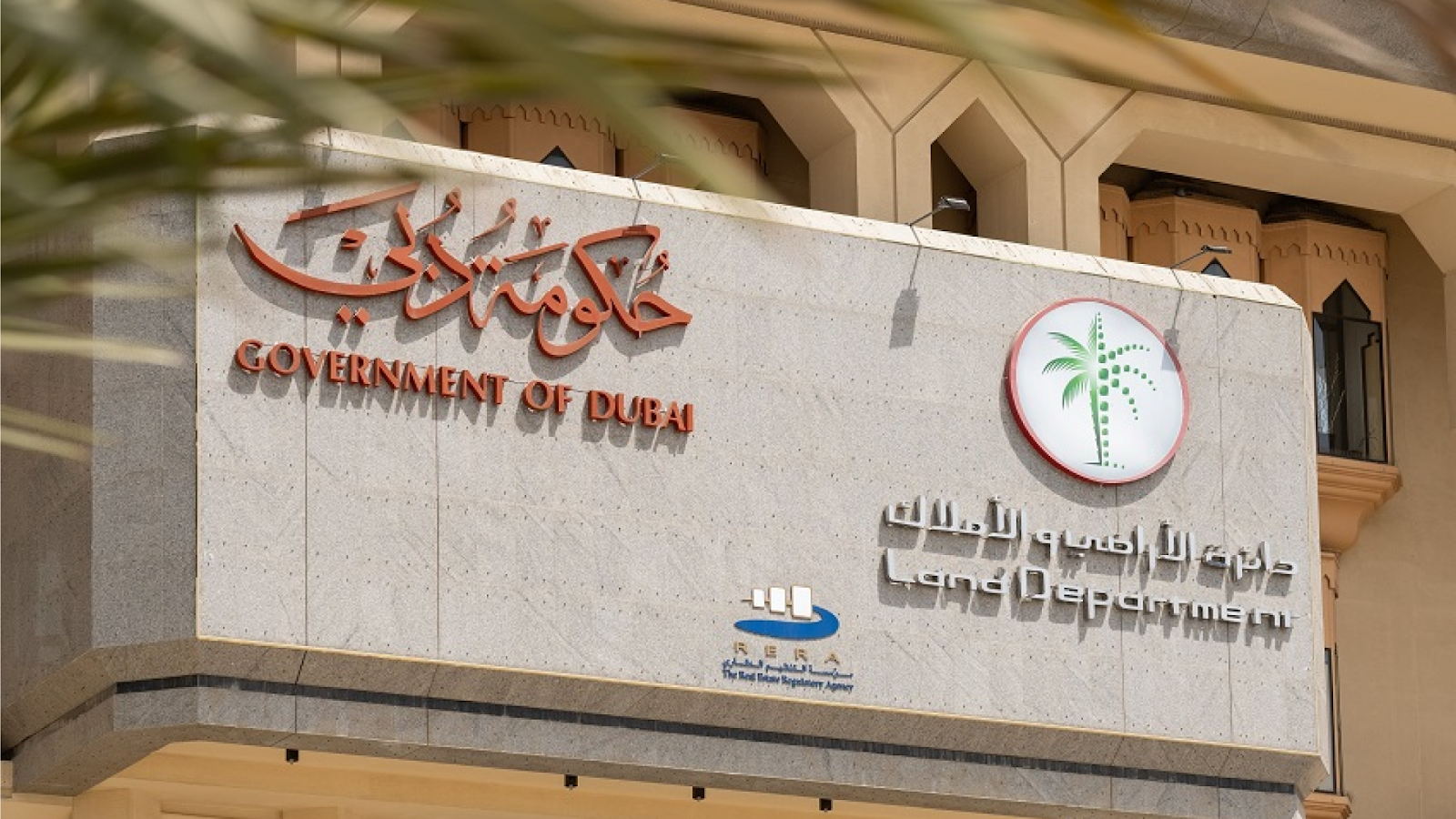
- Property transfer fee: 4% of the sale price (usually split, but negotiable).
- Mortgage registration: 0.25% of the loan amount + admin
(Source: Dubai Government)
Other Associated Costs

- Registration Fees: Additional registration fees may apply, depending on the property value. In Dubai, the Dubai Land Department charges a standard 4 % transfer/registration fee on the property price, and fixed administrative registration fees vary by value (e.g., around AED 2,000 + VAT for properties below AED 500,000 and AED 4,000 + VAT for properties above). (Source: Engel & Völkers)
- Real Estate Agent Commission: Typically, a real estate agent's commission is 2% of the purchase price. This fee is usually paid by the buyer. (Source: Binghatti)
- Mortgage Registration Fees: If the property is purchased with a mortgage, a mortgage registration fee of 0.25% of the loan amount, plus AED 290, is payable to the DLD. (Source Dubai Government)
- NOC (No Objection Certificate) Fees: Developers charge a NOC fee, which can range from AED 500 to AED 5,000, to issue a certificate allowing the transfer of property. (Source: Property Finder)
- Service Charges: For properties in community developments, annual service charges are levied to cover the maintenance and upkeep of common areas and facilities. These vary depending on the development and property type.
VAT (Value Added Tax) Implications
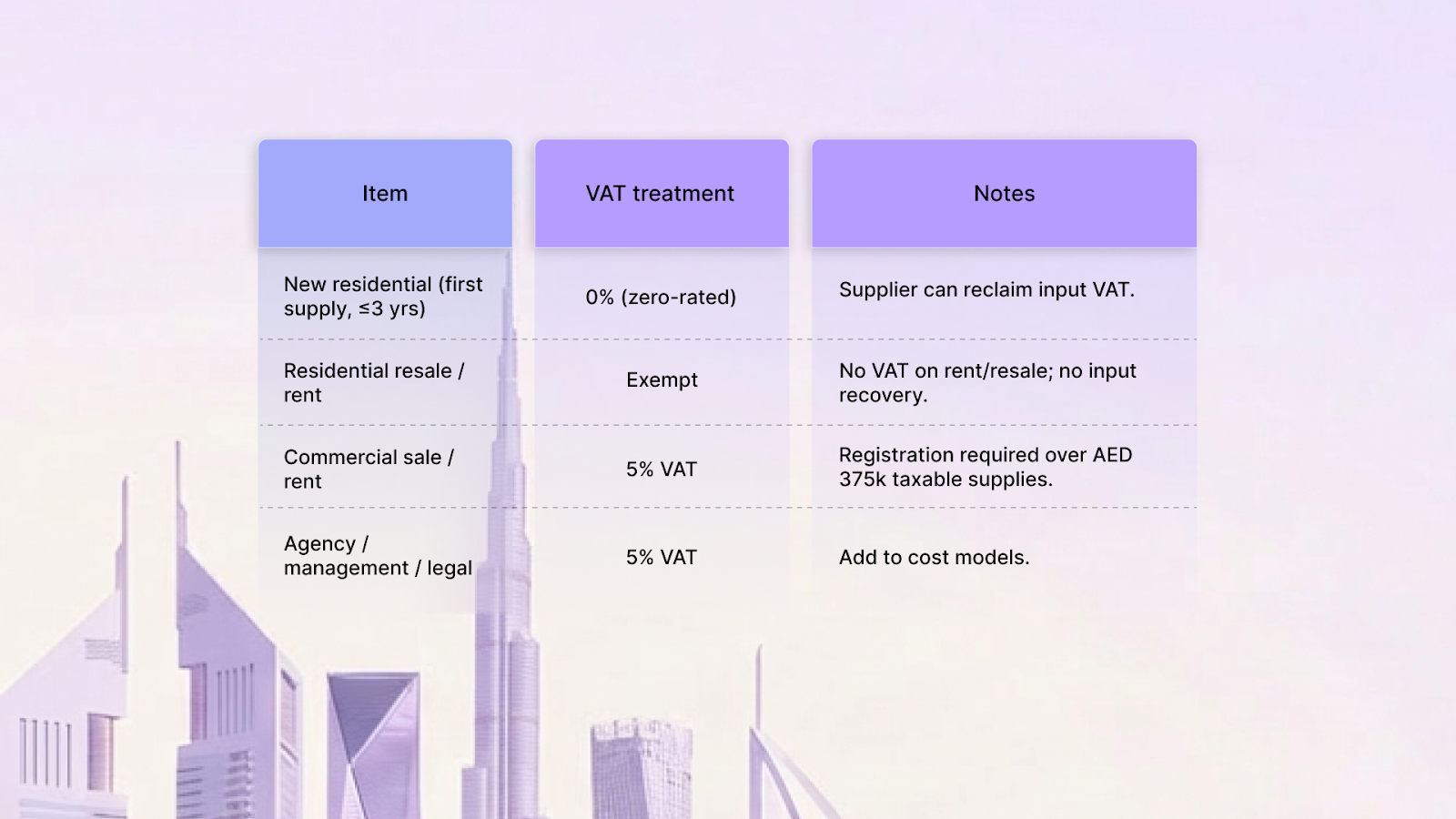
Value Added Tax (VAT) was introduced in the UAE in 2018 at a standard rate of 5%. While residential property sales are generally zero-rated (for first sale within three years of completion) or exempt (for subsequent sales), commercial property transactions are subject to VAT. (Source: Finance Ministry, UAE)
- Residential Property: The first supply of new residential properties within three years of their completion is zero-rated for VAT. Subsequent sales of residential properties are exempt from VAT. This means that while VAT is technically applicable, the rate is 0% for new properties, and no VAT is charged on resale. (Source: Finance Ministry, UAE)
- Commercial Property: Sales and leases of commercial properties (e.g., offices, retail spaces) are subject to the standard 5% VAT rate. Investors in commercial real estate need to account for this in their financial planning. (Source: Finance Ministry, UAE)
- Property-related services: Brokerage, property management, legal and maintenance services supplied by VAT-registered businesses are subject to 5% VAT. Remember to add this when budgeting.
Quick view:
Service Charges and Municipal Obligations

These are not taxes, but they are mandatory running costs that hit your net yield.
Annual service charges

Building and community upkeep (security, cleaning, amenities) are billed per sq ft per year and vary by asset class and building. Check the RERA Service Charge Index for your tower/community before you buy. (Rates differ widely by building quality and amenity level.)
Dubai Municipality housing fee (DEWA bill)

The Housing Fee is 5% of annual rental value, billed monthly through DEWA. (Source: EGSH)
- Tenants: 5% of Ejari rent.
- Owners-occupiers: 5% of the estimated rental value (per RERA index).
[Source: EGSH]
Example: Annual rent AED 100,000 → Housing fee AED 5,000/year → ~AED 416.67/month on your DEWA bill.
Golden Visa Advantages (for Property Investors)
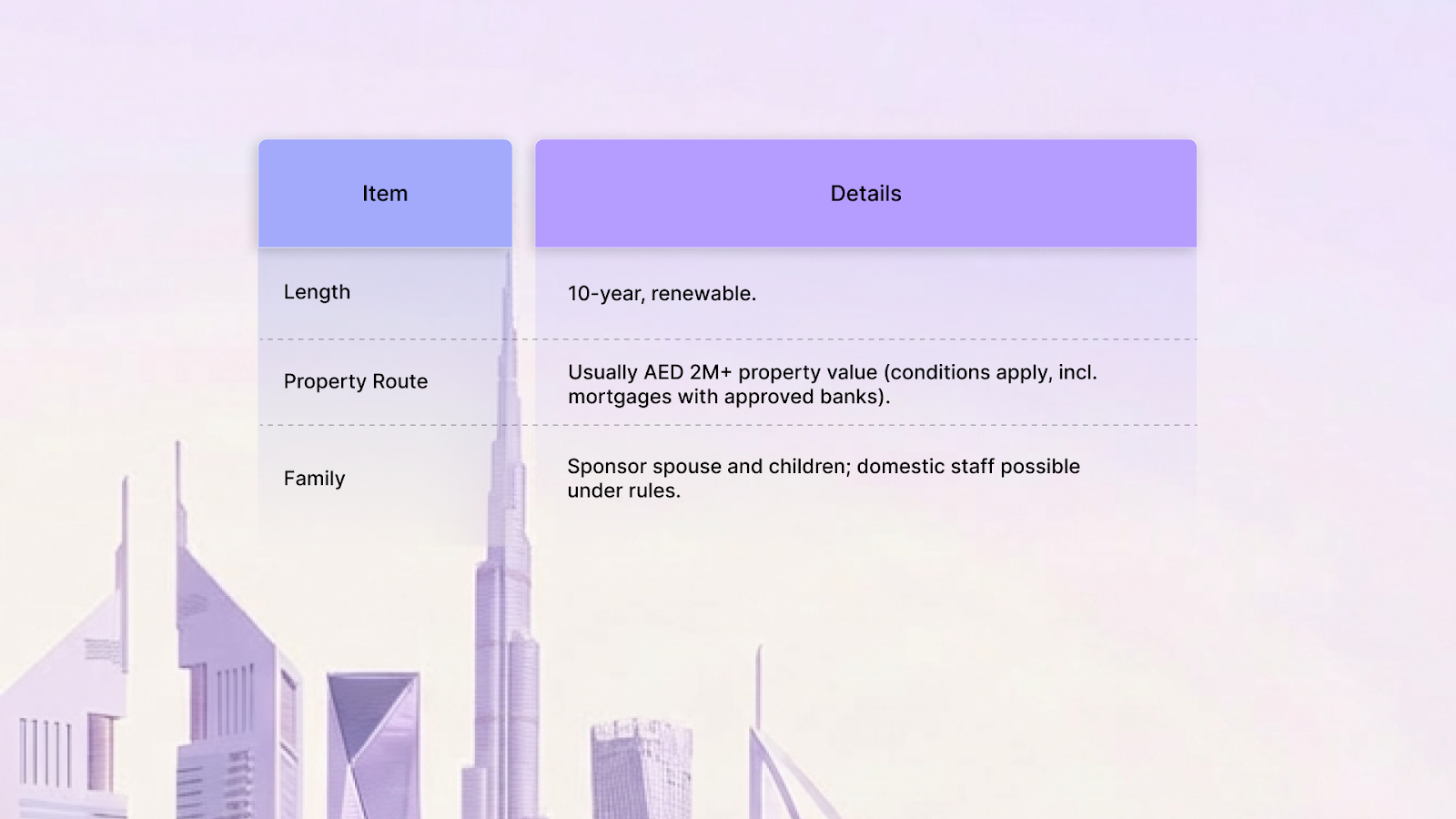
Dubai’s Golden Visa offers 10-year residency to qualifying investors. For property buyers, the usual investment threshold is AED 2 million (can include mortgaged property that meets rules). [Source: ICP]
Why it matters for taxes and planning
- The Golden Visa doesn’t change local tax rates (they’re already low), but it simplifies long-term planning and banking, often improving access to mortgages.
- It also supports multi-year holding strategies without residency uncertainty.
Golden Visa quick facts
Practical Tips (so you don’t leave money on the table)
- Calculate net, not gross. Add DLD fees, service charges, management, insurance, and (if relevant) VAT on services to your model.
- Know your classification. Passive landlord ≠ corporate taxpayer; active business may be. When in doubt, get a tax opinion.
- Get VAT right. Residential rents are exempt; commercial rents attract 5% VAT (and trigger registration over AED 375k).
- Track Housing Fee. It’s small, monthly, and easy to forget in yield models. [Source: u.ae]
- Plan your exit. That 4% DLD fee hits again for the buyer; price negotiations often reflect it.
2025 Tax Updates and Compliance Changes
Recent tax developments in the UAE have introduced new considerations for property investors, particularly regarding depreciation rules and compliance requirements.
Investment Property Depreciation Rules
The UAE Ministry of Finance introduced new depreciation rules for investment properties held at fair value, effective for tax periods beginning January 1, 2025. Under Ministerial Decision No. 173 of 2025, taxpayers who elect the realisation basis can claim an annual depreciation deduction equal to 4 % of the property’s original cost (or the tax written-down value if lower), providing a meaningful tax benefit for corporate property holders. (Source: PwC UAE tax alert)
While primarily benefiting corporate investors, these rules demonstrate the UAE's commitment to maintaining competitive tax treatment for real estate investment. Individual investors continue to benefit from tax-free income, while corporate structures gain additional tax planning flexibility.
Enhanced Compliance Requirements
Anti-money laundering (AML) compliance requires comprehensive documentation of fund sources for property purchases. Investors must demonstrate clear audit trails for investment funds, protecting market integrity while ensuring continued access to international banking systems. (Source: AMCA)
Tax Planning Strategies for Dubai Property Investors

Effective tax planning in Dubai focuses on maximizing the benefits of the tax-free environment while ensuring compliance with applicable regulations.
Structuring Multiple Property Investments
Investors building substantial property portfolios should carefully consider the individual vs. business activity distinction. Maintaining passive investor status preserves tax-free treatment but may limit certain business deductions and financing options. Conversely, operating as a licensed business enables professional tax planning but triggers corporate tax obligations.
The optimal structure depends on portfolio size, investment strategy, and administrative preferences. Investors approaching the business activity threshold should seek professional advice to evaluate the costs and benefits of different structures.
International Tax Considerations
Dubai's tax advantages are most valuable when coordinated with home country tax obligations. The UAE's double taxation agreements prevent double taxation, but investors must understand their home country's treatment of foreign property income.
Estate Planning and Succession
Dubai's absence of inheritance tax creates opportunities for efficient wealth transfer. Establish clear succession plans through UAE wills or international estate planning structures that recognize Dubai property ownership.
FAQ Section
Q1: Is there an annual property tax in Dubai?
No, individual property owners in Dubai are generally not subject to annual property taxes. This is a significant advantage, reducing the ongoing costs of property ownership and enhancing the profitability of real estate investments in the emirate.
Q2: Do I pay capital gains tax when selling property in Dubai?
For individual investors, there is typically no capital gains tax levied on the profit made from selling property in Dubai. This policy encourages investment and allows investors to retain the full appreciation of their asset's value.
Q3: Is rental income from Dubai properties taxed?
Individual investors earning rental income from properties in Dubai are generally exempt from income tax on these earnings. This makes real estate an attractive option for generating tax-free passive income streams.
Q4: How does the new UAE Corporate Tax affect property investors?
The UAE Corporate Tax primarily impacts businesses. For natural persons, real estate income is generally excluded unless activities require a business license or are deemed frequent trading. Corporate entities involved in real estate will be subject to the 9% corporate tax on taxable profits.
Q5: What are the main fees associated with buying property in Dubai?
The primary fee is the Dubai Land Department (DLD) transfer fee of 4% of the property value, usually paid by the buyer. Other costs include registration fees, real estate agent commissions (2% + VAT), mortgage registration fees, and NOC fees from developers.
Q6: Is VAT applicable to residential property transactions in Dubai?
New residential properties sold within three years of completion are zero-rated for VAT (0%). Subsequent sales of residential properties are exempt from VAT. Commercial property transactions, however, are subject to the standard 5% VAT rate.
Q7: Can foreign investors own property in Dubai?
Yes, foreign investors can own freehold property in designated areas of Dubai. The government actively encourages foreign investment in the real estate sector, offering various incentives and a clear legal framework for ownership.
Deed's Take: Simplifying Tax Compliance Through Fractional Investment
For many investors, the complexities of tax compliance, even in a tax-free jurisdiction like Dubai, can be overwhelming. Property ownership involves understanding VAT obligations, service charge management, municipal fee compliance, and potential corporate tax implications. This administrative burden often deters investors or leads to costly compliance mistakes.
Deed's fractional investment platform eliminates these complexities while preserving all tax advantages. As a DFSA-regulated platform, we handle all compliance obligations on behalf of our investors. Our investors receive their proportional share of rental income without worrying about VAT registration, municipal fee payments, or service charge management.
The tax treatment remains identical to direct property ownership—rental income flows to investors tax-free, and any capital appreciation upon property sale is exempt from capital gains tax. However, investors avoid the administrative burden and compliance risks associated with direct ownership.
With minimum investments starting at AED 500, Deed makes tax-efficient Dubai property investment accessible to a broader range of investors while ensuring professional-grade compliance and management.
Conclusion
Navigating the tax implications of property investment in Dubai is crucial for maximizing returns and ensuring compliance. While Dubai offers a remarkably tax-friendly environment with no annual property, capital gains, or rental income taxes for individuals, understanding transactional fees and the nuances of corporate tax is essential. The emirate's robust real estate market, coupled with supportive government policies, continues to present lucrative opportunities for investors worldwide. By leveraging the insights provided in this comprehensive guide, investors can make informed decisions and confidently embark on their Dubai property investment journey. For personalized advice and to explore investment opportunities, consult with a qualified real estate advisor or tax professional specializing in the Dubai market today.
__________________________________________________
For promotional purposes only. Property and other details may vary. Capital at risk. Deed is regulated by the DFSA.
Senior Growth, Marketing & Brand Manager | Elevating Brand Equity & Fueling Sales Growth Across Fintech, Proptech.
Signup to our newsletter!
Stay ahead with exclusive updates, insights, and opportunities delivered straight to your inbox.
Frequently Asked Questions

Start earning passive income today
Join thousands of investors building wealth through fully-managed rental properties.