


How to Analyze Dubai Property Market Trends for Better Investment Decisions

Analyze Dubai’s property market cycles using supply, demand, rental yields, and transaction data to time entries, manage risk, and spot value in 2026.


KEY takeaways
How to Analyze Dubai Property Market Trends for Better Investment Decisions
Summary
Dubai's property market moves in cycles that can make or break investment portfolios. While the city has delivered exceptional returns over the past few years, with prices rising 70% since 2019, major rating agencies now predict significant changes ahead]. Understanding how to analyze market trends isn't just helpful—it's essential for protecting your capital and identifying the best opportunities.
This guide provides analytical investors with the frameworks and tools needed to read market signals, interpret expert forecasts, and make data-driven investment decisions. Whether you're timing your entry into the market or planning your exit strategy, mastering trend analysis will give you the edge you need to succeed in Dubai's evolving property landscape.
Why Market Analysis Matters for Dubai Property Investment
Dubai's property market is uniquely dynamic, influenced by factors ranging from government policy to global economic shifts. Unlike more stable markets, Dubai can experience rapid price movements that create both exceptional opportunities and significant risks for unprepared investors.
- Cycles accelerate in Dubai. After a powerful run-up through 2024/25, several agencies now see double-digit corrections ahead as a large new-home pipeline completes. Translation: discipline beats FOMO.
- Demand is still real. Population growth (and shrinking household size) keeps underlying demand resilient—even if supply creates short-term turbulence. Smart investors separate structural from cyclical forces.
- The cycle is maturing. Record transaction values and volumes alongside slowing rental growth signal a late-expansion market that’s rotating toward a supply-led phase.
One-line takeaway: 2026 may bring better entry points. The edge comes from a repeatable process, not one grand prediction.
Understanding Dubai’s Market Cycles and Current Position

Dubai’s property market moves in repeatable cycles. Those cycles are shaped by three forces:
supply vs. demand, economic growth, and policy shifts.
Knowing where we are in the cycle is the difference between buying momentum and buying value—especially as you plan for the Dubai real estate market 2026 outlook.
A quick cycle recap (2000 → today)
- 2003–2008 (boom): Easy credit and rapid building.
- 2009 (reset): Prices fell 40%+ and the market required a $20B backstop—hard proof that supply-demand gaps can bite (Source: Guardian).
- 2012–2019 (repair & consolidation): Selective growth, tighter rules, and better market plumbing.
- 2020–2025 (expansion): COVID-era policy support, infrastructure spend, and visa reforms pulled in global buyers; pricing and volumes surged.
Where we are now (late-expansion → early-correction)
Several late-cycle signals are flashing at once:
- Liquidity at records: About 51,000 homes traded in Q2-2025 (Source: Reiden); AED 761B of transactions in 2024 (Source: Dubai Government). Liquidity is strong—but late-cycle peaks often are.
- Affordability stretch: Prices have outrun incomes in several sub-markets, a classic sign of cycle fatigue.
- Supply loading: A large delivery pipeline is lining up for 2025–26. That shifts the market from demand-led to supply-led conditions in many pockets.
- Rent deceleration: Rental growth cooled from ~21% YoY to ~8.5% by May 2025, an early tell that momentum is easing (Source: Aurantius).
Bottom line: These signals suggest a transition phase. The Dubai property market forecast into 2026 skews to softer pricing in supply-heavy zones, while well-located, end-user areas should prove more resilient.
Read the luxury lead
High-end segments usually lead turns—up and down. Over 590 homes above AED 20M sold in Q1-2025. Elevated luxury volumes can mark late-cycle heat; when trophy activity cools, it often precedes broader slowdowns. Use that as an early-warning gauge rather than a headline to chase.
What this means for timing
- If you buy into strength, price with a cushion and demand real value (incentives, better specs, stronger management).
- If you’re patient, watch for handover clustering and rent stabilization in your target micro-markets—those are classic setups for value entries.
- In all cases, shift from citywide averages to area-level absorption and building-level economics before you act.
Takeaway: The cycle is maturing. Expect more dispersion by community and asset type. Process beats prediction: track supply maps, rent trends, incentives, and absorption—and let those signals drive your 2026 plan.
The indicators that actually matter (and how to read them)
Successful market analysis requires monitoring the right indicators and understanding what they reveal about future trends. Dubai's market offers several reliable data sources that analytical investors should track regularly.
1) Supply pipeline (your leading indicator)

- Track announced, under construction, and handover timelines.
- Map deliveries by micro-market, then compare historic absorption there.
- Clustering risk = many buildings completing in the same quarter → more concessions, longer lease-up times.
Why it matters: In Dubai, supply timing moves rents and prices. The 2025–2027 pipeline (≈ 150k–210k units) is the headline driver behind most 2026 forecasts. [Source: Reuters; Gulf News,]
Rule of thumb: If handovers cluster in your target pocket, add more vacancy weeks and a -3–5% rent haircut to your model.
2) Population & demographics (demand base)

- Population growth matters, but so does household size. When households get smaller, the city needs more units per capita.
- Watch employment in finance, tech, logistics, and hospitality. These sectors power tenant demand.
Why it matters: A growing, diversified population supports long-run demand—even during a cyclical cooldown.
3) Transactions & pricing (liquidity and sentiment)

- Rising volumes + values = strength.
- Rising volumes with slower rent growth can mark late-cycle behavior.
- Falling volumes before prices? Often an early warning.
Why it matters: Liquidity conditions affect entry/exit ease. The 2024–H1 2025 surge in sales value alongside rent deceleration is a classic sign of maturing cycles.
4) Rental yields (and net math)

- Gross yield is rent ÷ price.
- Net yield subtracts service charges, management fees, realistic vacancy, and maintenance.
Why it matters: Dubai still offers ~6% gross on average, competitive versus many global hubs. But after price gains, yields compress unless you buy keenly or choose value-led pockets. [Source: Global Property Guide, 2025]
Rule of thumb: Compare areas on net using identical assumptions. Then stress-test: rent −3–5%, +2–4 vacancy weeks.
5) Developer & bank health (shock absorbers)

- According to Reuters, UAE banks have significantly reduced their exposure to real estate. Property-related loans now make up about 14% of total bank lending, down from around 20% a few years ago.This means banks are less dependent on the property sector than in the past, making the system more resilient even as the real estate cycle matures.[Source: Reuters]
- Better balance sheets reduce systemic risk vs. past cycles.
Why it matters: Corrections can still happen, but the system is sturdier, making spiral-type declines less likely.
6) Foreign capital & luxury flows (cycle cues)

- Track HNW inflows, visa programs, and luxury closings.
- Changes in transaction volume at the trophy-home end are commonly used as an early indicator of risk appetite and potential turning points in the wider property cycle.
Where to get the data (and how to use it)
- Dubai Land Department (DLD): Official transactions, developer registrations, and sector updates. Day-one source for volumes/values.
- Deloitte, Global Property Guide: Market overviews, yield comps, and structural context.
- News & ratings: Reuters (Fitch calls), Gulf News (Moody’s coverage), Bloomberg (sentiment, luxury flows).
Workflow (monthly):
- Pull DLD transactions for your short-list areas.
- Update your rent/yield sheet with live asks and recent leases.
- Overlay handover maps for the next 12–24 months.
- Re-run your net yield and scenario matrix.
- Scan ratings/news for macro or policy shifts.
Key Valuation Methods
Investors should be familiar with various property valuation methods to assess potential investments accurately. These include:
- Capitalization Rate (Cap Rate): This measures the rate of return on a real estate investment property based on the income that the property is expected to generate. It is calculated by dividing the net operating income by the property’s current market value.
- Gross Rent Multiplier (GRM): A simplified valuation metric that compares the property’s price to its annual gross rental income.
- Comparative Market Analysis (CMA): This involves comparing the subject property to similar properties that have recently sold or are currently on the market in the same area. This method helps in determining a fair market value.
- Return on Investment (ROI) and Return on Equity (ROE): These fundamental indicators measure the profitability of an investment relative to its cost or equity. ROI assesses the efficiency of an investment, while ROE measures the return on the owner’s investment.
How professionals build a Dubai property market forecast
Professional analysts use systematic approaches to forecast market trends that individual investors can adapt for their own analysis. Understanding these methods helps investors interpret expert predictions and develop their own analytical capabilities.
A) Supply–demand modeling (the backbone)

- Demand inputs: population (+6% in 2024), GDP (3.2% growth), tourism (+9% overnight visitors).
- Supply inputs: delivery curve; slippage risk (delays), clustering risk (many handovers at once).
- Outcome: Models point to imbalance risk starting late-2025/2026; magnitude depends on absorption and policy.
B) Comparative market analysis (CMA)

- Compare current price-to-income, yield, and affordability to past peaks and peer cities.
- With yields still competitive yet affordability stretched since 2019, a modest-to-moderate correction scenario makes sense.
C) Macro integration

- Tie property to GDP, employment, rates, tourism, and the growth agenda (e.g., D33).
- Macro lenses explain long-run support while you position for near-term cycles.
D) Scenario planning (turn forecasts into actions)

Build a three-path matrix:
- Base: handovers staggered; demand okay → -5% to -8% prices.
- Downside: clustered supply; global risk-off → -10% to -15%.
- Upside: delivery delays; strong inflows → 0% to -3%.
For each path, define entry, position size, cash buffer, and exit conditions.
Interpreting Expert Predictions and Rating-Agency Reports
Forecasts are useful—but only if you know what each forecaster models, what they assume, and what they tend to miss. Read every outlook through that lens before you act.
What each source is really telling you
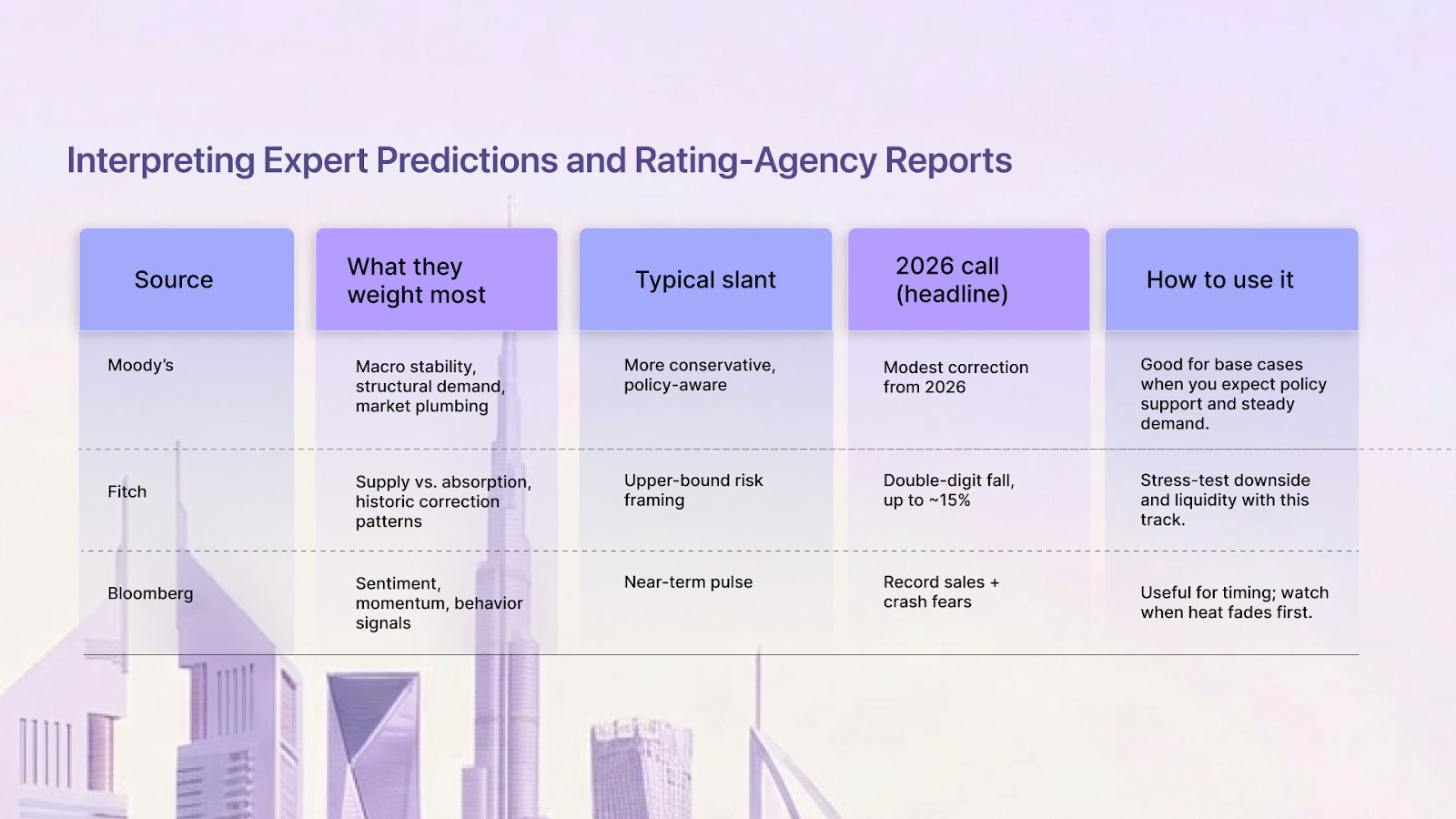
Quick read: Moody’s helps frame the base path. Fitch sharpens your downside. Bloomberg informs entry/exit timing. Use all three; don’t anchor on one.
How to reconcile different headlines
- Build a consensus band instead of a single number. Today that band is –5% to –15% into late-2025/2026, driven by the handover schedule.
- Then layer local absorption and policy response on top. If deliveries stagger or policy eases, the path skews to the shallower end. If handovers cluster and global risk is “off,” prepare for the deeper side.
Read the methodology, not just the headline
- Inputs: Does the model include actual handover timing by micro-market, or only citywide totals?
- Assumptions: What do they assume for rent growth, mortgage costs, and population inflows?
- Feedback loops: Do they reflect how developers cut launches, add incentives, or delay deliveries when demand softens?
Answering these three questions tells you whether a forecast fits your assets and areas.
Limits you should keep in mind
- Policy shifts can be fast. Dubai has a track record of intervening to steady conditions; models may not adapt in time.
- Geopolitics can swing flows (tourism, HNWI migration) quickly. Agency base cases rarely capture sharp turns.
- Micro-market dispersion gets lost in city averages. Your tower can outperform even if the city slows.
A simple investor workflow
- Triangulate: Start with Moody’s for base, layer Fitch for downside, use Bloomberg to sense timing.
- Scenario it: Build three paths (base, downside, upside) and pre-decide your actions for each.
- Track three live signals:
- Handover clustering in your pocket (next 12–24 months).
- Rent trend (is deceleration slowing or deepening?).
- Incentives (developer freebies, longer rent-free, fee waivers).
- Gate your move: Only buy when your pre-set signals align with the scenario you’re underwriting.
Treat forecasts as inputs, not answers. Your edge comes from process + local data, not a single headline.
Factors Influencing Dubai’s Property Market
Several external and internal factors continually shape Dubai’s property market. A holistic analysis requires considering these influences.
Economic Growth and Diversification: Dubai’s robust economic growth, driven by its diversification efforts beyond oil into tourism, trade, logistics, and finance, directly impacts the real estate sector. A strong economy attracts businesses and individuals, increasing demand for residential and commercial properties.
Government Policies and Regulations: The UAE government and the DLD play a significant role in shaping the property market through policies, regulations, and strategic initiatives. Recent visa reforms, such as the Golden Visa program, have attracted long-term residents and investors, boosting demand. The Dubai Real Estate Sector Strategy 2033, for example, aims to enhance the sector’s competitiveness and attractiveness [3].
Global Economic Conditions: As a global hub, Dubai’s property market is susceptible to global economic conditions, including interest rate changes, inflation, and geopolitical events. For instance, global economic slowdowns can impact foreign investment flows into Dubai.
Infrastructure Development: Continuous investment in world-class infrastructure, including transportation networks, smart city initiatives, and new urban developments, enhances Dubai’s appeal and property values. Projects like Expo City Dubai and various master-planned communities contribute to sustained growth.
Demographics and Population Growth: Dubai’s growing population, particularly its expatriate community, fuels demand for housing. Understanding demographic shifts, such as the influx of high-net-worth individuals, can provide insights into future market trends and specific property segments that will experience higher demand.
Timing Investment Decisions Based on Market Trends
Reading the market is only half the job. The other half is turning signals into moves—when to enter, when to trim, and how to rebalance without guessing tops or bottoms. Here’s a playbook you can apply in Dubai’s fast-moving cycle.
Entry: two proven playbooks
1) Counter-cyclical (buy the dip—carefully)

- When to consider: During a correction, provided long-run demand (population, jobs, infrastructure) still looks healthy.
- Watch for these early bottoming signs:
- Transaction volumes stabilize after falling.
- Fewer new launches; developers start offering incentives (fee waivers, post-handover plans).
- Price cuts slow; days-on-market plateau.
- How to execute: Enter in stages. Underwrite rent –3–5% and add 2–4 vacancy weeks in your net-yield math. Target micro-markets where handovers are spaced out, not clustered.
2) Momentum (ride the early recovery)
- When to consider: After the trend turns up—you see 3–6 months of firmer prices, rising rents, and improving absorption.
- Signals to require:
• Sustained pickup in transactions (not one good month).
• Rental growth re-accelerates; concessions fade.
• Developers’ guidance turns constructive without relying on heavy incentives.
• How to execute: Pay slightly more for confirmation. Prioritize liquid, end-user-heavy pockets where resale and leasing are dependable.
Exit: reading peaks without guessing tops

Peak tells to respect:
- Record sales volumes alongside stretched affordability and aggressive launch calendars.
- Rent growth decelerating even as prices climb (late-cycle divergence).
- Luxury cools first (trophy sales normalize), often leading broader segments.
Two exit methods (pick one and pre-commit):
- Signal-based trim: Scale back 10–30% when multiple peak tells align.
- Staggered exit: Drip out over several months/quarters to avoid timing a single top.
Strategic portfolio management while you time entries/exits
- Sector rotation: Tilt between off-plan vs. ready, apartment vs. villa, luxury vs. mid-market as the cycle evolves.
- Geographic diversification: Pair core, liquid zones (Downtown/Marina/Business Bay) with growth corridors only where infrastructure is real (not just announced).
- Barbell approach: Anchor with durable, end-user stock (1BR/2BR in deep rental pools) and keep a small sleeve for higher-beta opportunities.
- Liquidity buffer: Hold cash for unexpected vacancy, repairs, or opportunistic bids during volatility.
A simple timing checklist

- Define your lane: Counter-cyclical or momentum (or stage entries if long-term).
- Map supply: Handover timelines in your target micro-market for the next 12–24 months; avoid quarters with clustering.
- Track three live signals: transactions (trend), rents (direction), incentives (tightening/loosening).
- Model net yield under stress: rent −3–5%, +2–4 vacancy weeks, real service charges/management.
- Gate your action: Only deploy when your pre-set signals match your strategy’s rules.
Treat timing as a process, not a hunch. If your signals disagree, wait; capital preserved today is optionality tomorrow.
FAQ Section
Q1: What are the primary indicators to analyze in the Dubai property market?
A1: Key indicators include property prices, rental yields, transaction volumes, and supply-demand dynamics. Monitoring these provides a comprehensive view of market health and potential investment opportunities.
Q2: Where can I find reliable data on Dubai real estate trends?
A2: The Dubai Land Department (DLD) is the official source for data. Reputable real estate consultancies like Deloitte and Knight Frank also publish valuable reports and insights.
Q3: How do government policies impact the Dubai property market?
A3: Government policies, such as visa reforms (e.g., Golden Visa) and strategic initiatives like the Dubai Real Estate Sector Strategy 2033, significantly influence demand, supply, and overall market stability.
Q4: What are the risks associated with investing in Dubai real estate?
A4: Risks include market volatility, potential regulatory changes, and economic downturns. Mitigation strategies involve diversification, thorough due diligence, and adopting a long-term investment perspective.
Q5: Is it better to invest in off-plan or ready properties in Dubai?
A5: Off-plan properties have historically shown higher capital appreciation potential, attracting investors seeking future gains. Ready properties offer immediate rental income and are suitable for those prioritizing stable yields.
Q6: How does global economic conditions affect Dubai’s property market?
A6: As a global hub, Dubai’s market is sensitive to global economic shifts, including interest rate fluctuations, inflation, and geopolitical events, which can impact foreign investment flows.
Q7: What is the significance of rental yield in Dubai property investment?
A7: Rental yield indicates the annual return on investment from rental income. It's crucial for income-focused investors to assess profitability and compare different property opportunities.
DEED's Take
At Deed, we understand that successful property investment requires more than just market access—it demands sophisticated market analysis and timing expertise. Our platform provides investors with the analytical tools and market insights needed to navigate Dubai's complex property cycles.
We continuously monitor the key indicators discussed in this guide, from supply pipeline analysis to demographic trends, ensuring our investment opportunities align with favorable market conditions. Our research team synthesizes insights from multiple rating agencies and market sources to provide balanced, actionable market intelligence.
How DEED Supports Analytical Investors
Our platform offers real-time market data, trend analysis, and investment timing guidance that helps analytical investors make informed decisions. We provide detailed market reports, supply-demand analysis, and cycle positioning insights that complement the frameworks outlined in this guide.
With fractional ownership starting at AED 500, Deed enables investors to implement sophisticated timing strategies without requiring large capital commitments. This flexibility allows for gradual market entry, portfolio rebalancing, and risk management strategies that align with market cycle analysis.
Conclusion: Mastering Market Analysis for Investment Success
Analyzing Dubai real estate market 2026 trends requires combining multiple analytical frameworks with real-time market monitoring and professional risk management. The current market environment presents both challenges and opportunities for analytical investors who understand how to read the signals.
The consensus Dubai property market forecast suggests significant changes ahead, with supply pressure likely to create correction opportunities in 2026. However, strong underlying fundamentals including population growth, economic diversification, and improved market structure support long-term investment prospects.
Success in Dubai's property market comes from understanding cycles, timing decisions based on data rather than emotion, and maintaining disciplined risk management approaches. Use the frameworks and indicators outlined in this guide to develop your own analytical capabilities and make informed investment decisions.
Remember that market analysis is an ongoing process, not a one-time exercise. Stay informed about changing conditions, adapt your strategies as new data emerges, and always maintain adequate diversification and liquidity to navigate market volatility successfully.
Your investment success depends on combining analytical rigor with practical market knowledge. Start applying these frameworks today to position yourself for the opportunities and challenges that lie ahead in Dubai's evolving property market.
__________________________________________________
For promotional purposes only. Property and other details may vary. Capital at risk. Deed is regulated by the DFSA.
Senior Growth, Marketing & Brand Manager | Elevating Brand Equity & Fueling Sales Growth Across Fintech, Proptech.
Signup to our newsletter!
Stay ahead with exclusive updates, insights, and opportunities delivered straight to your inbox.
Frequently Asked Questions

Start earning passive income today
Join thousands of investors building wealth through fully-managed rental properties.