


How to Exit Dubai Real Estate Investments: Timing and Strategy Guide

Learn when and how to sell Dubai property using market cycles, supply signals, and seasonal timing to maximize net proceeds and redeploy capital efficiently.


KEY takeaways
- A market-cycle framework to time exits using volumes, price momentum, rental trends, and supply pipelines
- Seasonal selling windows that show which quarters in Dubai attract the most qualified buyers and fastest closings
- A step-by-step sale plan to price, stage, market, and negotiate for maximum net proceeds—not just top-line price
- Off-plan exit playbooks for timing assignments at peak demand while protecting IRR and paid-in capital
- Portfolio rebalancing rules to decide which assets to sell and where to redeploy for higher yield or growth
- Data-led indicators to spot early warning signs of pricing pressure before the market turns
How to Exit Dubai Real Estate Investments: Timing and Strategy Guide
Buying well is half the game. Exiting well is the other half.
Dubai’s property market moves in cycles. Prices can rise fast when demand outpaces supply and cool when new stock hits the market. If you sell in a rush, you pay for it—through discounts, duplication of fees, and higher days on market. If you plan your exit, you keep more of your gains and free up capital for your next move.
This comprehensive guide provides exit-planning investors with proven strategies for maximizing returns when selling Dubai real estate. Learn optimal timing, market analysis techniques, and strategic exit planning to achieve your investment goals in Dubai's dynamic property market.
Why Exit Strategy Matters (and when to start)
Dubai's real estate market reached AED 66.8 billion in sales during May 2025 alone (Source: Property Finder), with over 181,000 deals recorded in 2024 representing a 36% year-on-year increase (Source: Next Level Real Estate). For exit-planning investors, understanding when and how to sell can mean the difference between modest gains and exceptional returns. A well-timed exit strategy can deliver 10-25% additional profit during market peaks, while poor timing can result in extended holding periods and reduced returns.
- You lock in real returns only at exit. Unrealized gains are paper gains.
- Timing gap is real. Buyer demand can flip in weeks; supply pipelines move in months.
- Costs compound. Transfer, agency, mortgage discharge, and vacancy can shave 1–3%+ off proceeds if unmanaged.
- Capital redeployment. A smooth exit lets you pivot into higher-yield assets without sitting on the sidelines.
Takeaway: Start exit planning 90–120 days before you intend to market. If you hold via a fractional platform, check your next secondary-market window or vote-to-sell rules early.
Understanding Dubai’s Real Estate Market Cycles (and How They Shape Your Exit)

Dubai’s property market moves in clear cycles. Prices and activity rise as demand outpaces supply, then cool when new stock floods in or external conditions shift. If you plan your exit around these waves—not against them—you’re far more likely to lock in top-tier results.
Fitch Ratings highlighted that after years of strong price growth, a large planned supply surge (210,000 units) could push prices down up to 15%, illustrating how new stock influences the cycle. (Source: Reuters)
Where the market is now (2025)
- Transaction activity remains elevated, with record monthly volumes and sustained buyer demand across segments.
Multiple reports confirm elevated transaction volumes and values in 2025:
- Dubai’s real estate sector recorded record activity in 2025, with over AED 682 billion in annual sales and rising transaction counts compared with 2024. (Source: Lifer)
- Residential volumes stayed strong earlier in 2025, with Q1 transaction value jumping ~29% YoY and >42,000 deals. (Source: PR Newswire)
- Average prices are up versus prior years, but a large pipeline of new homes scheduled for handover in the near term could create pockets of pricing pressure.
There’s publicly available data showing rising prices in 2025:
- Market reports noted transaction values and prices continue to strengthen in 2025, with average sales value growth across residential segments. (Source: FLX Property)
- Independent data also shows asking prices rising year-on-year, e.g., apartments up 12% in early 2025 compared with prior years.(Source: Global Property Guide)
- Luxury continues to lead headline numbers, yet mid-market and family areas show more stable, utility-driven demand.
Reports show strong sales across both luxury and more affordable segments:
- Dubai’s market in 2025 saw broad sales strength in both high-end and more affordable tiers, with luxury and under-AED 2 M segments posting strong performance. (Source: Arabian News)
- Translation for sellers: this is still a supportive market, but you should watch supply handovers and affordability closely before setting your exit timeline. The broader cycle context—strong volumes, decelerating rents in some sub-markets, and a well-telegraphed supply pipeline—supports careful, data-led timing.
The combination of strong volumes, decelerating rental growth, and supply considerations forms a sensible narrative:
- Rental growth in mid-2025 decelerated to around 8.5 % YoY, moderating from previous higher rates — a sign of momentum easing that sellers should consider. (Source: Mieyar)
Market Timing Indicators: How to Know It’s a Good Moment to Sell
Use these signals together—no single metric should drive your decision.
1) Sales volume (pace of deals)

- Rising volumes usually signal a seller’s market: listings move faster, negotiations are shorter, and qualified buyers bid with confidence.
- Flat or falling volumes—especially if listings are rising—often precede longer time-to-sell and softer pricing.
2) Price trend (speed and breadth of growth)

- Broad-based appreciation across unit sizes and communities often marks a late-expansion phase (a favorable, but narrowing, window for exits).
- If price gains concentrate in a few luxury pockets while mainstream areas flatten, consider bringing forward your sale.
3) Supply pipeline (what’s completing near you)

- Track upcoming handovers by community and unit type. When like-for-like stock is set to arrive in clusters (e.g., several towers completing within a quarter), consider exiting 3–6 months before visible supply peaks.
- If your asset offers differentiation (view, floor plan, renovation, parking), you can still command a premium—just set a tighter marketing plan.
4) Affordability and financing conditions
- Watch effective mortgage costs and loan-to-value terms. Easing rates or improved lending appetite can expand the buyer pool, lifting achievable prices.
- Conversely, tighter credit or reduced borrowing power can lengthen marketing time—even in “healthy” markets.
5) Rental momentum (for income assets)

- Slowing rent growth or rising vacancy in your micro-market can be an early sign to review your hold thesis.
- If you’re selling a leased unit, a well-priced, renewed tenancy with a strong tenant profile often improves exit liquidity.
6) Policy and sentiment

- Residency, visa, and ownership rules, plus large infrastructure announcements, can move demand quickly.
- When sentiment is exuberant (multiple bids, off-plan queues), consider staged exits: sell part of the portfolio now, retain select outperformers for later.
- If you hold fractional shares via a platform, know the platform’s exit windows and secondary-market mechanics—timing those cycles can matter as much as the broader market.
Bottom line: Read volumes, prices, supply, and rent momentum together. This “four-lens” view aligns with professional cycle analysis frameworks used by institutional investors.
Seasonal Timing: Dubai’s Best (and Toughest) Quarters to Exit

Dubai’s climate and international buyer calendar create predictable waves of viewing activity. Align your listing to the busiest windows.
Q1 (Jan–Mar): Prime exit window
- Cool weather, peak footfall, and “new-year decision energy.”
- Major events and exhibitions bring global buyers.
- Properties listed in Q1 typically get more qualified viewings and tighter days-on-market.
Q4 (Oct–Dec): Second-best window
- Market re-energizes after summer.
- Expat families are back; investors look to deploy before year-end.
- Great for relaunches (if Q1 didn’t hit your target) and for well-presented, move-in-ready units.
Q2 (Apr–Jun): Mixed, front-loaded
- April/early May can still be strong.
- Activity tapers into late Q2 (Ramadan/heat). Serious buyers remain, but casual viewing declines—plan sharper pricing and marketing.
Q3 (Jul–Sep): Slowest season
- Heat, travel, and lower on-ground activity.
- If you must sell, expect longer timelines and negotiate accordingly. Cash buyers may be more active; your best lever is standout presentation and a clear value story.
How to Turn Indicators into a Sale Plan (Step-by-Step)
Step 1 — Micro-market scan (4–6 weeks before listing)

- Pull 90-day sales comps for your tower and immediate neighbors.
- Map upcoming handovers (same bed count/size) within a 3–6-month window.
- Check rent renewals and advertised rents for your unit type.
Step 2 — Price and prep strategy

- Set a launch price within the top quartile of recent comps if your unit has differentiators; otherwise, target the median with a plan for a Stage-2 adjustment in 21–30 days if traffic lags.
- Invest in high-ROI upgrades: paint, lighting, deep clean, minor snag fixes; furnish selectively in investor-heavy areas to widen the buyer pool.
Step 3 — Listing calendar

- Aim for Q1 or Q4 when possible. If supply is about to surge in your block, list before handovers complete.
- For tenanted units, align listing with lease milestones (notice periods, RERA increase caps) to maximize buyer flexibility.
Step 4 — Deal mechanics

- Prepare all documents (Title Deed, service-charge statement, NOC requirements) before launch to shorten escrow time.
- For cash buyers, tighten timeline incentives; for financed buyers, pre-share DLD valuation comps to smooth approvals.
Step 5 — Review and adapt

- In week 3, reassess: If viewings <2 per week or offers sit >3% below ask with consistent feedback, execute your Stage-2 price/terms adjustment.
- If multiple offers appear, choose the bid with the highest certainty of close (financing readiness, deposit size, timelines), not just top sticker price.
Strategic Exit Planning Framework
A great exit is not luck. It’s a plan. Use the steps below to match your property, the market, and your goals—then pick the exit that fits.
1) Choose your exit path

Open-Market Resale
The traditional approach involves listing your property through real estate agents or digital platforms to attract the broadest buyer pool. This strategy works best in high-demand areas like Downtown Dubai, Dubai Marina, and Business Bay where capital appreciation has been significant.
Open-market sales provide maximum price discovery and negotiation opportunities. However, they require patience and may involve multiple viewings and negotiations before closing.
Property Flipping Strategy
Short-term investors often employ flipping strategies, particularly with off-plan properties. This approach involves purchasing undervalued or pre-construction units, potentially adding value through strategic improvements, and reselling for quick profits.
Successful flipping requires careful market timing, understanding of buyer preferences, and accurate cost estimation. The strategy works best in rapidly appreciating markets with strong buyer demand.
Lease-Option Agreements
This hybrid approach combines rental income with future sale potential. You lease the property to tenants while granting them purchase options at predetermined prices. This strategy provides steady cash flow while maintaining exit flexibility.
Lease-options work particularly well for investors who want to avoid vacancy periods while keeping future sale options open. The approach requires careful contract structuring and tenant selection.
Portfolio Rebalancing
Sophisticated investors use strategic asset disposal to optimize their overall portfolio composition. This might involve selling certain properties to reinvest in higher-growth areas, different property types, or alternative investment classes.
Portfolio rebalancing allows investors to maintain optimal risk-return profiles while adapting to changing market conditions and personal financial goals.
Quick Glance:
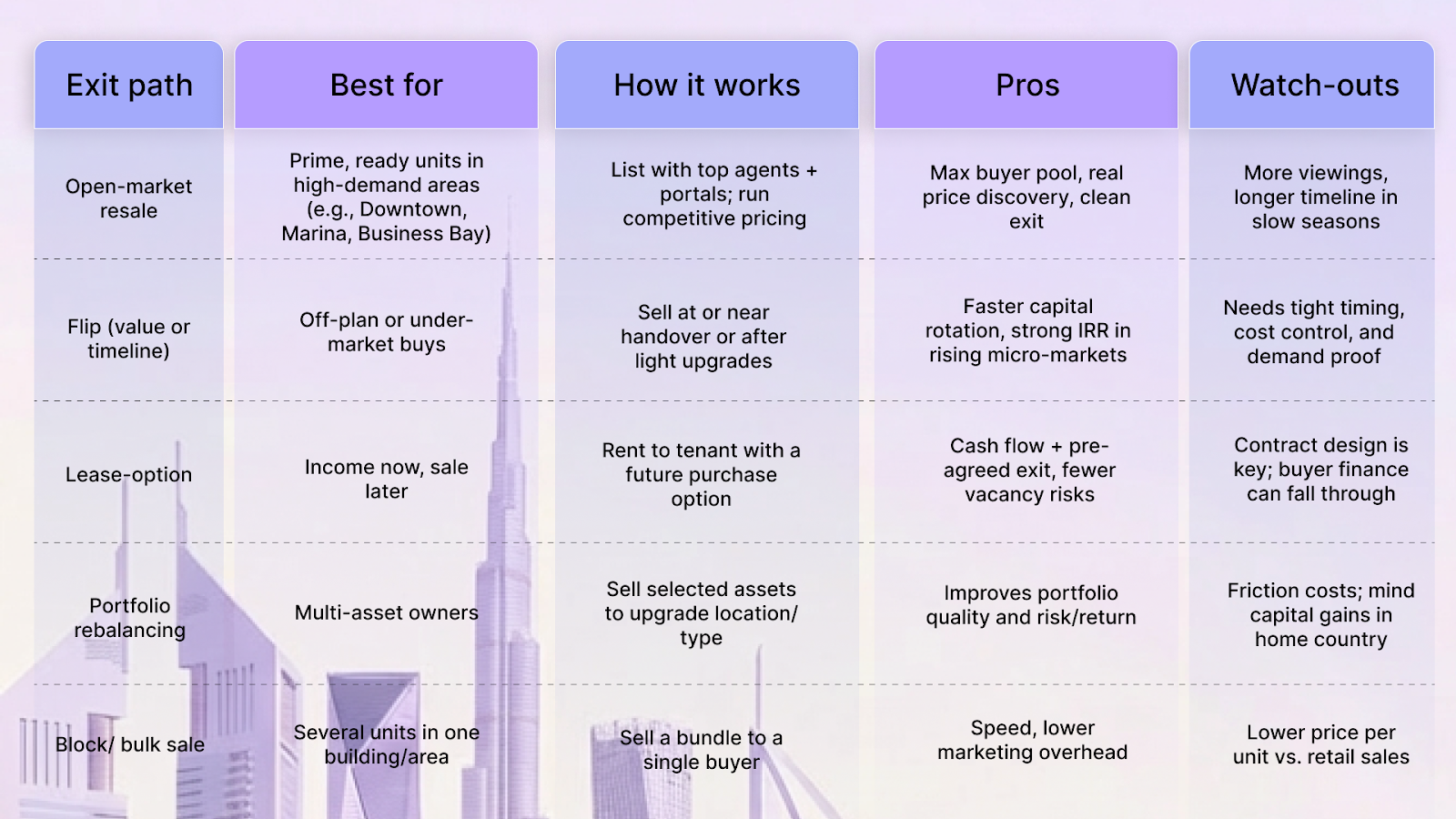
Tip: sanity-check timing with hard signals—supply pipeline, transaction volumes, and rental yield drift—before you list.
2) Open-market resale: when to pull the trigger

- Signs it’s time: days-on-market falling, buyer enquiries rising, price index trending up in your sub-market.
- Pricing: anchor to recent registered transfers and live competition, not wish prices.
- Proof: order a DLD Smart Valuation and run at least one independent calculator to stress-test net proceeds.
3) Property flipping: do it like a pro

- Where flips work: projects with clear catalysts (handover, new metro, new mall) and visible buyer demand.
- Two playbooks:
Timeline flip (off-plan): enter early, exit at ~70–80% construction when end-user demand peaks. Keep paid-in cash exposure modest to protect IRR.
Value flip (ready): buy at a discount, add light capex that tenants and buyers value (kitchens, flooring, lighting), then relist.
- Guardrails: set a target minimum spread (e.g., 10–12% above all-in cost), a max hold (e.g., 6–9 months post-handover), and a walk-away rule if absorption softens.
4) Lease-option: income today, exit tomorrow

- Why use it: steady cash flow now, plus a defined sale price later; reduces vacancy risk in slower markets.
Keys to success:
- Option fee (non-refundable) + clear strike price and timeline.
- Tenant screening (finance track record).
- Lawyer-drafted terms aligned with RERA rules on renewals and notices.
5) Portfolio rebalancing: upgrade what you own

- What to sell: high-capex, low-yield units; single-tenant risk; assets facing new competing supply.
- What to buy: units with stronger NOI growth drivers (transit, schools, new demand hubs), or property types that offset your current risk (e.g., add a 1-bed in JVC to balance a luxury 3-bed on the Palm).
- How to decide: track portfolio-level yield, DSCR, and vacancy trend. Reallocate where each dirham earns more.
Off-Plan Exit Strategies and Timing
Off-plan can be a great exit—if you respect the clock.
Your timing window
- Sweet spot: when construction hits ~70–80%. At this stage, perceived risk drops, marketing picks up, and more end-users qualify for mortgages.
- Payment exposure: many investors target 30–40% paid-in before listing to keep capital light and IRR high.
- Proof of demand: watch absorption in that project/cluster, not just city-wide headlines. Rising enquiries + fewer incentives from the developer are green lights.
- Stress-test: model your exit using live comps and official valuations; don’t rely on the launch brochure.
Where off-plan flips tend to work
- Established, growing communities (e.g., JVC, Business Bay) where rental demand is deep and new supply gets absorbed.
- Emerging nodes tied to a clear catalyst (new road/metro, business park, school). Use predictive tools to quantify the uplift before you commit.
Fast checklist before listing an off-plan assignment
- Assignment rules in your SPA (fees, minimum paid-in %, developer consent).
- Buyer finance eligibility timelines.
- Registered comparables + unsold developer inventory in the same stack.
- Your true breakeven (price minus all fees, premiums, and marketing).
Execution playbook
- Decide the “why”

De-risk? Take profit? Rebalance? Tax/home-country need? Your “why” sets price and urgency.
- Pick the path

Use the table above. If speed > price, consider bulk/buyer networks. If price > speed, go retail open-market.
- Price with data, not hope

Combine DLD Smart Valuation, real-time comps, and a regulated calculator to net out fees and debt payoff.
- Stage and story

Fix small defects. Upgrade low-cost, high-impact items. Package a one-page “deal memo” with NOI, service charges, and tenant status—buyers pay for clarity.
- Launch and learn

Go live across top portals + agent networks. Review enquiries and price feedback weekly. Adjust in 14-day sprints.
- Negotiate the net

Focus on net proceeds + timeline, not just top-line price. Tighten special conditions (handover date, snag liability, furniture list).
- Close clean

Prepare transfer file early (Title Deed, NOC plan, service-charge statement, paid utility proofs). Pre-book DLD transfer to avoid delays.
Use data to time the market (and your exit)
- Market health: supply pipeline, monthly volumes, rent momentum, and affordability gauges help you spot peaks and slowdowns. Build your exit around those signals, not gut feel.
- Micro-market edge: AI-driven tools can flag early oversupply, shifting yields, and buyer sentiment so you exit before pricing pressure hits.
The Selling Process in Dubai
Exiting a Dubai real estate investment involves a structured process:
- Valuation: Obtain an accurate valuation of your property from a reputable real estate agent or valuer. This helps in setting a competitive asking price.
- Marketing: Work with a real estate agent to market your property effectively. This includes professional photography, online listings, and open houses.
- Offer and Negotiation: Review offers from potential buyers and negotiate terms. A skilled agent can be invaluable during this stage.
- Memorandum of Understanding (MOU): Once an agreement is reached, a MOU is signed, outlining the terms and conditions of the sale.
- No Objection Certificate (NOC): Obtain a NOC from the developer, confirming that all service charges and dues are cleared.
- Transfer of Ownership: The final step involves transferring the property ownership at the Dubai Land Department (DLD). This typically requires the presence of both buyer and seller (or their representatives) and payment of DLD fees.
Legal and Financial Considerations
Navigating the legal and financial aspects of exiting a Dubai real estate investment is crucial for a smooth transaction.
- Capital Gains Tax: Currently, Dubai does not impose a capital gains tax on real estate. However, it is essential to stay updated on any changes in tax regulations.
- Fees and Charges: Be aware of various fees, including real estate agent commissions (typically 2% + VAT), DLD transfer fees (4% of the property value), and mortgage release fees (if applicable).
- Currency Exchange: For international investors, fluctuations in currency exchange rates can impact the net proceeds from the sale. Consider hedging strategies if this is a concern.
- Legal Counsel: Engaging a legal professional specializing in Dubai real estate can help ensure compliance with all regulations and protect your interests throughout the selling process.
Market Risk Assessment and Mitigation
Understanding and managing risks is crucial for successful exit planning in Dubai's dynamic property market.
Supply and Demand Dynamics
The market faces a significant supply increase with 210,000 new units expected in 2025-2026, potentially creating pricing pressure in certain segments. However, prime locations like Palm Jumeirah and Dubai Creek Harbour are expected to maintain value due to limited supply and high demand [2].
Investors should monitor supply pipelines in their specific areas and consider timing exits before major project completions that could flood local markets with competing inventory.
Market Volatility Considerations
Potential price corrections of up to 15% are forecast for the second half of 2025, particularly if supply significantly outpaces demand. However, Dubai's strong fundamentals, including population growth and continued foreign investment, support long-term market stability [2].
Investors can mitigate volatility risks through careful timing, competitive pricing, and maintaining flexibility in their exit strategies. Diversified portfolios across different areas and property types also help manage market-specific risks.
Building Your Exit Action Plan

Successful property exits require systematic planning and execution across multiple phases.
Phase 1: Market Assessment and Timing
Begin by analyzing current market conditions in your specific area and property type. Review recent sales data, absorption rates, and upcoming supply to identify optimal exit windows.
Consider seasonal factors and align your timeline with peak selling periods when possible. Factor in any personal constraints or financial requirements that might influence timing decisions.
Phase 2: Strategy Selection and Preparation
Choose your exit strategy based on market conditions, property characteristics, and investment goals. Prepare all necessary documentation and address any property improvements or repairs that could enhance sale value.
Engage professional services including RERA-certified agents, legal advisors, and property management companies as needed to ensure smooth transaction execution.
Phase 3: Execution and Optimization
Implement your chosen strategy with careful attention to pricing, marketing, and negotiation tactics. Monitor market feedback and be prepared to adjust pricing or strategy based on buyer response.
Maintain flexibility throughout the process while staying focused on your primary objectives and acceptable outcome parameters.
FAQ Section
Q1: What is the best time to sell property in Dubai?
The best time often aligns with peak market conditions, typically characterized by high demand, increasing prices, and strong economic indicators. Selling before an anticipated oversupply or major project completions can also be advantageous.
Q2: Are there taxes on selling property in Dubai?
Currently, Dubai does not impose capital gains tax on real estate. However, sellers are responsible for various fees, including DLD transfer fees (4%) and real estate agent commissions (typically 2% + VAT).
Q3: How long does the property selling process take in Dubai?
The duration can vary, but typically, from listing to transfer of ownership, it can take anywhere from 1 to 3 months, depending on market conditions, buyer readiness, and efficiency of documentation.
Q4: What is an off-plan exit strategy?
An off-plan exit strategy involves buying a property during its construction phase and selling it before or shortly after completion, aiming to profit from the appreciation during the development period.
Q5: Should I use a real estate agent to sell my property in Dubai?
While not mandatory, using a reputable real estate agent is highly recommended. They provide market expertise, handle marketing, negotiations, and navigate the legal complexities, often leading to a quicker and more profitable sale.
Q6: What are the main costs associated with selling a property in Dubai?
Key costs include the 4% DLD transfer fee (paid by the buyer, but sometimes negotiated), 2% real estate agent commission plus VAT, and potential mortgage release fees if the property is mortgaged.
Q7: How can I ensure a smooth property transfer at the DLD?
Ensure all outstanding service charges and utility bills are cleared, obtain a No Objection Certificate (NOC) from the developer, and have all necessary documents prepared. Engaging a legal professional can further streamline the process.
Deed's Take: Fractional Ownership Exit Advantages
For investors seeking greater liquidity and flexibility, fractional ownership platforms like Deed offer compelling exit alternatives to traditional property sales.
Deed's fractional ownership model allows investors to exit positions in smaller increments rather than selling entire properties. This provides several advantages including improved liquidity, reduced transaction costs, and greater portfolio management flexibility.
The platform's DFSA regulation and professional asset management ensure investor protection while providing access to high-quality Dubai properties with monthly rental income distribution. Investors can adjust their exposure levels based on market conditions and personal financial goals without the complexity of full property transactions.
Conclusion
Successfully exiting a Dubai real estate investment is a strategic endeavor that requires a deep understanding of market dynamics, precise timing, and a well-executed plan. By carefully considering market cycles, employing appropriate exit strategies like off-plan flipping or long-term holding, and navigating the legal and financial landscape with expert guidance, investors can maximize their returns and mitigate potential risks. The Dubai real estate market continues to offer compelling opportunities, but only those with a clear exit strategy will truly capitalize on its potential. Don't leave your investment's future to chance. Plan your exit strategy today to secure your financial success in Dubai's vibrant property market.
__________________________________________________
For promotional purposes only. Property and other details may vary. Capital at risk. Deed is regulated by the DFSA.
Senior Growth, Marketing & Brand Manager | Elevating Brand Equity & Fueling Sales Growth Across Fintech, Proptech.
Signup to our newsletter!
Stay ahead with exclusive updates, insights, and opportunities delivered straight to your inbox.
Frequently Asked Questions

Start earning passive income today
Join thousands of investors building wealth through fully-managed rental properties.