


How to Scale Your Dubai Real Estate Investment Portfolio: Growth Strategies

Learn how to scale your Dubai property portfolio using smart leverage, diversification, cash-flow systems, and exit strategies to grow returns without increasing risk.

KEY takeaways
How to Scale Your Dubai Real Estate Investment Portfolio: Growth Strategies
Scaling a property portfolio in Dubai isn’t about “buying more.” It’s about compounding the systems that already work—deal flow, financing, operations, and risk controls—so each new property adds profit without adding chaos.
Dubai is one of the few markets where you can do that at speed. The city has deep liquidity, clear rules, and constant tenant demand. It also offers multiple ways to grow: rent-ready apartments, build-to-rent communities, value-add refurbishments, and fractional exposure for cash-efficient diversification.
This guide explores effective strategies to expand your real estate investments in Dubai, a dynamic market offering significant growth potential. Learn how to diversify, optimize returns, and navigate the market to build a robust and profitable portfolio.
Why Portfolio Scaling in Dubai Matters Now
Dubai's real estate market has evolved into one of the world's most sophisticated investment environments, offering compelling opportunities for portfolio expansion. The emirate recorded 180,900 transactions valued at over AED 522 billion in 2024, representing a 36% increase over the previous year (Source: Emirates News). This unprecedented activity signals a mature market ready for serious portfolio scaling strategies.
For experienced investors, the current environment presents unique advantages. Regulatory maturity, global connectivity, and investor-friendly frameworks are attracting institutional capital while creating opportunities for sophisticated individual investors to scale efficiently. The key lies in understanding that successful portfolio scaling requires more than simply buying more properties—it demands strategic thinking, operational excellence, and market timing.
The stakes are higher than ever. Properties in certain Dubai master-planned communities have benefited from strong capital appreciation between off-plan purchase and completion, with typical value uplifts of 15–30 % and occasional higher gains in particularly active micro-markets. (Source: Pre-Launch Property Investment). However, this growth also means that scaling strategies must be more sophisticated to maintain competitive returns while managing increased capital requirements and market complexity.
Portfolio Scaling vs. Property Accumulation (and the Strategies That Actually Grow Returns)
Scaling a Dubai real estate portfolio isn’t about hoarding doors. It’s about compounding performance—each new asset should lift the returns, resilience, and liquidity of the whole portfolio. Below is a clear, practical framework that turns “more properties” into more profit.
What “Portfolio Scaling” Really Means
Property accumulation = buying more units.
Portfolio scaling = growing a system where every new acquisition improves the performance of the rest through smarter financing, better mix, and tighter operations.
A scaling mindset looks at:
- Geographic mix (exposure to different demand drivers)
- Property-type mix (cash-flow vs. growth)
- Cash-flow quality (reliable income > headline yield)
- Exit orchestration (sell the right asset, at the right time, for the right reason)
Investor profiles (and scaling relevance):
- Owner-occupier: lifestyle first; scaling is secondary.
- Owner-investor: occupies some units but “ladders up” strategically.
- Pure investor/landlord: rentability and capital gains drive decisions—most scalable profile.
Growth Strategies for scaling your Dubai Real Investment Portfolio
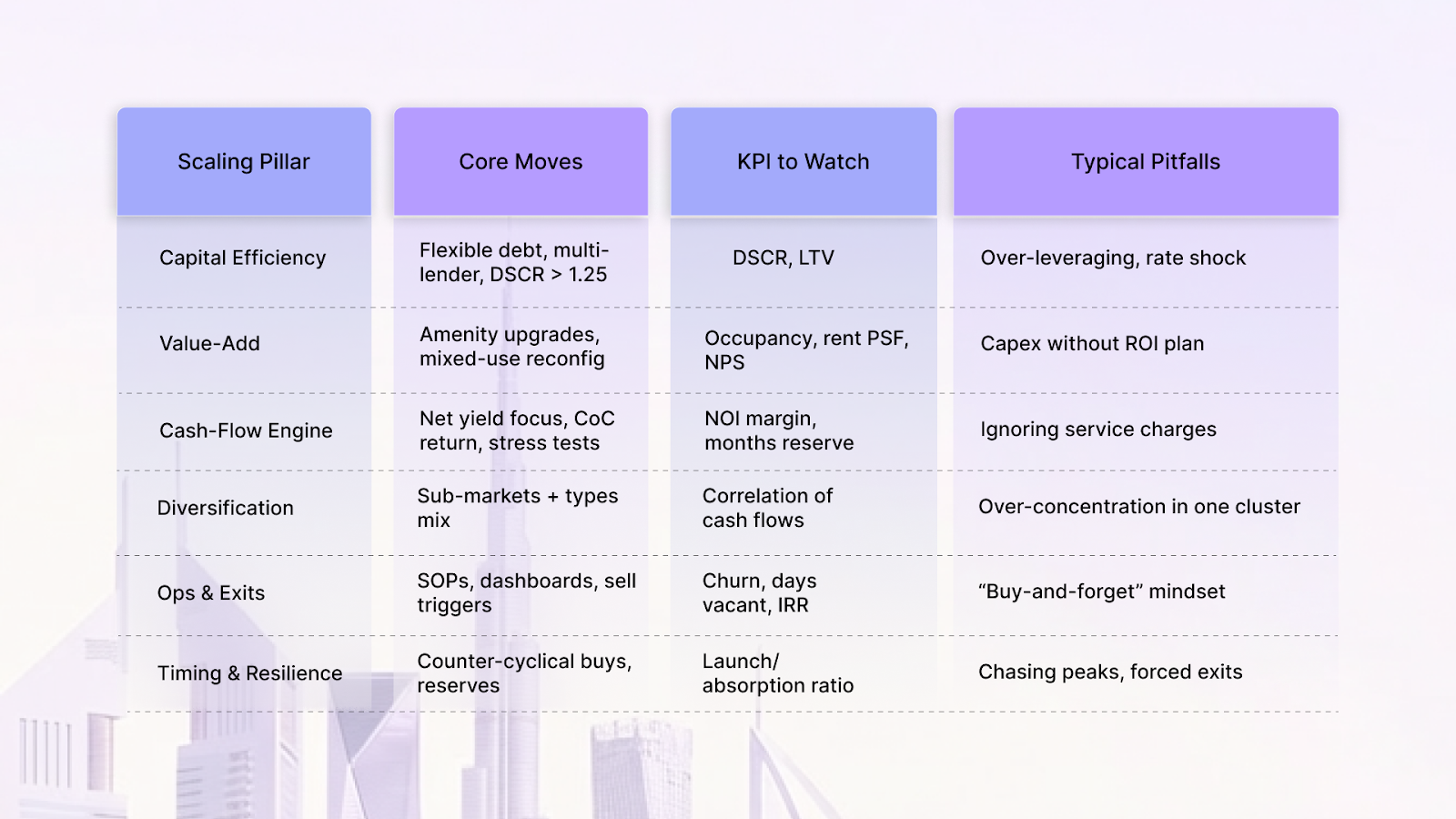
1) Strategy Pillar: Capital Efficiency & Smart Leverage

Don’t trap all your cash in each purchase. Use financing to stay liquid so you can take the next deal when it appears.
A. Optimize Financing Structures
- Seek prepayment flexibility and rate review options.
- Maintain multiple lender relationships to keep terms competitive.
- Consider both conventional and Sharia-compliant solutions; pick the one that best fits your cash-flow rhythm.
B. Set Leverage to Match Your Risk
- Typical LTV bands for income assets: ~50–60% (context-dependent).
- Keep portfolio DSCR > 1.25 to absorb vacancies or rate moves.
- Conservative scalers: 40–50% LTV for stronger cushions.
- Aggressive scalers: 60–70% LTV to expand faster (with tighter controls).
C. Use Cross-Collateralization (When It Helps)
- One facility secured by multiple assets can mean lower rates and faster acquisitions.
- Balance the benefit against the web of liens it creates—document exit paths.
2) Strategy Pillar: Value-Add & Repositioning (Accelerate Equity Growth)

Create value beyond market appreciation.
A. Asset Enhancement Programs
- Upgrade common areas, modernize MEP, improve services.
- In regulated rent environments, focus on desirability (not just rent hikes).
- Tie capex to measurable KPIs: higher occupancy, shorter voids, better tenant profile.
B. Mixed-Use Repositioning
- Convert low-yield retail corners into wellness, hospitality, or amenity spaces with premium rents.
- Use local demand signals (footfall, demographics, spend data) to prioritize conversions.
C. Operational Excellence = Value Creation
- Standardize leasing, handovers, maintenance SLAs, and tenant comms.
- The result: higher tenant satisfaction, lower churn, better liquidity at exit.
3) Strategy Pillar: Cash-Flow Optimization (Fuel for Scaling)
Cash flow is your scaling engine. Protect it, grow it, reinvest it.
A. The Cash-Flow Scaling Model
Buy assets that produce reliable monthly surplus after debt and opex.
Example: Rent AED 2,500 – Expenses AED 1,800 = AED 700 surplus.
That surplus funds the next deposit, upgrade, or repayment.
B. Quick Screen: The 1% Rule (Use as a Filter, Not a Law)
- Target monthly rent ≈ 1% of price for initial screening (e.g., AED 200,000 price ⇒ ~AED 2,000 rent).
- Then run full underwriting (NOI, DSCR, stress tests).
C. Analyze Like a Pro
- Net rental yield after service charges, maintenance, vacancy, and interest.
- Cash-on-cash return for true capital productivity.
- Stress test vacancy and rate scenarios before you buy.
D. Benchmarks (Illustrative)
- Prime Dubai sub-markets often deliver ~6–8% gross yields.
- Example: 2-bed serviced unit at AED 2.2M with AED 176k rent ≈ 8% gross—now model to net.
4) Strategy Pillar: Diversification by Sub-Market & Property Type

Diversification reduces shocks and captures multiple demand cycles.
A. Sub-Market Mix
- Business Bay: strong professional tenant base; liquid leasing.
- Dubai Islands: luxury waterfront appeal; lifestyle premium.
- Dubai Hills Estate: family-centric, schools and green spaces; stable tenancies.
B. Property Type Mix
- Off-plan: lower entry prices, higher upside; more timeline risk.
- Ready units: immediate income; simpler operations—great for compounding.
- Luxury stock: slower yield, stronger long-term capital growth if well-located.
C. Spot Emerging Areas Early
- Track government agendas (e.g., D33), transport projects, and master plans.
- Enter ahead of major amenity and infrastructure milestones.
5) Strategy Pillar: Active Management & Exit Orchestration

Scaling = running a small operating company, not just a group of deeds.
A. Professional Management Systems
- Move from ad-hoc to SOPs: leasing cadence, preventive maintenance, vendor SLAs.
- Align renewals with RERA rules to capture fair increases and avoid disputes.
- Watch service charges—they hit NOI directly; negotiate and audit where possible.
B. Portfolio-Level Dashboards
- Track occupancy, AR, average days vacant, expense ratio, NOI per asset, and trend lines.
- Flag underperformers for capex, re-tenancy, or disposal.
C. Plan Exits Before You Enter
- Define your sell triggers: yield compression, capex cliff, sub-market saturation, or target IRR met.
- Use partial block sales or unit-by-unit disposals based on buyer depth and liquidity.
6) Strategy Pillar: Market Timing & Resilience
You don’t control cycles—but you can position for them.
A. Know the Cycle
- Macro drivers: global rates, oil, tourism, population, policy.
- Local signals: launch volumes, absorption, rent growth deceleration, incentives.
B. Play Counter-Cyclical
- Accumulate quality assets when fear (not fundamentals) drags prices.
- Upgrade and stabilize during softer periods; exit when liquidity peaks.
C. Build Holding Power
- Maintain cash reserves, moderate LTVs, diversified rent streams.
- Holding power prevents forced sales at discounts and lets you time exits.
At-a-Glance: The Scaling Blueprint
Quick Actions to Start Scaling (Responsibly)
- Audit your current portfolio: net yields, DSCR, vacancy risk, capex needs.
- Set allocation targets: % cash-flow vs. growth, % by sub-market.
- Refinance for flexibility: improve terms, build a dry-powder line.
- Pilot one value-add: upgrade, re-tenant, measure lift.
- Standardize ops: leasing calendar, maintenance cadence, BI dashboard.
- Write exit rules: sell discipline beats market guesswork.
- Pre-underwrite next 3 buys: so you can move when the window opens.
Scaling is a disciplined system, not a sprint. Use leverage wisely, protect cash flow, diversify your exposure, and run your portfolio like a business. Done right, every acquisition grows income, equity, and optionality—and makes the next one easier.
Governance & risk controls for bigger portfolios
- Liquidity ring-fence: Keep 6–12 months of OPEX + debt service.
- Stop-adding rule: Pause new buys if DSCR <1.3 or arrears >3% for 90 days.
- Rebalancing cadence: Quarterly; trim overweight sub-markets or formats.
- Exit playbooks: Pre-decide triggers (capex overrun, rent underperformance, negative comps trend).
- Platform risk check: Favor regulated, audited platforms with segregated client funds and clear voting/exit rules.
Platform selection that supports scaling
When you use platforms to scale, evaluate four things: regulation, minimums, fees, and exits.
- Regulation & investor protection: DFSA-regulated platforms operating under DIFC licenses offer stronger oversight (segregated client funds, capital rules, audits). Prioritize these as your foundation.
- Minimums: Lower minimums (e.g., AED 500) let you diversify faster across many tickets—a structural advantage while compounding.
- Fees: Model 5-year cost drag (entry/admin/exit/performance). The fee stack meaningfully alters IRR at scale.
- Exit windows: Understand hold periods, secondary markets, and biannual exits so your liquidity ladder works at portfolio level.
Technology and Data-Driven Scaling

Modern portfolio scaling relies on technology and data analytics to identify opportunities and optimize performance across multiple properties.
Market Intelligence and Analytics
Advanced investors use market intelligence platforms to analyze submarket performance and benchmark portfolio performance. These tools provide insights into rental trends, vacancy rates, and capital appreciation patterns across Dubai's submarkets.
Property Management Technology
Technology solutions become essential as portfolios scale. These platforms automate rent collection, maintenance scheduling, and financial reporting while providing real-time performance monitoring across multiple properties.
Risk Management in Portfolio Scaling

Successful portfolio scaling requires sophisticated risk management that addresses both individual property risks and portfolio-level exposures.
Diversification Strategies
Geographic diversification across Dubai's submarkets reduces exposure to localized market downturns or development issues. Property type diversification balances different risk-return profiles while capturing various market segments and tenant demographics.
Tenant diversification becomes increasingly important as portfolios scale. Avoiding concentration in specific tenant types or industries reduces vacancy risk and provides more stable cash flow during economic cycles.
Financial Risk Management
Leverage management across the portfolio ensures sustainable debt service coverage while maintaining capacity for strategic acquisitions. Maintaining adequate cash reserves provides flexibility to address unexpected expenses or market opportunities.
Building Your Scaling Action Plan

Successful portfolio scaling requires a systematic approach that balances growth ambitions with risk management and operational capabilities.
Phase 1: Foundation Building
Establish your scaling foundation with 2-3 well-performing properties that generate positive cash flow. Focus on understanding market dynamics and building management systems.
Phase 2: Strategic Expansion
Expand systematically across different submarkets and property types while maintaining cash flow discipline. Target 5-10 properties to achieve meaningful diversification.
Phase 3: Portfolio Optimization
Optimize performance through value-add strategies and professional management implementation as the portfolio approaches 10+ properties.
FAQ Section
Q1: What are the primary benefits of investing in Dubai real estate?
Dubai offers a tax-free environment, high rental yields, strong capital appreciation potential, and a stable economy. Its strategic location and world-class infrastructure attract global investors and residents, ensuring sustained demand. The government's investor-friendly policies further enhance its appeal as a prime real estate investment destination.
Q2: Is it better to invest in ready properties or off-plan properties in Dubai?
Both have advantages. Ready properties offer immediate rental income and clear market value. Off-plan properties often come with lower entry prices, flexible payment plans, and higher capital appreciation potential upon completion. The best choice depends on your investment goals, risk tolerance, and liquidity.
Q3: How can I mitigate risks when scaling my real estate portfolio in Dubai?
Mitigate risks through diversification across property types and locations. Conduct thorough due diligence on developers and properties. Maintain a healthy debt-to-equity ratio and avoid over-leveraging. Stay informed about market trends and regulatory changes, and consider professional property management for optimal returns and reduced hassle.
Q4: What role does financing play in scaling a Dubai real estate portfolio?
Financing, particularly mortgages, can significantly amplify your investment capacity by allowing you to control larger assets with less upfront capital. Dubai banks offer various mortgage products. Strategic use of leverage, combined with careful financial planning, can accelerate portfolio growth and enhance returns.
Q5: How important is market research for successful real estate scaling in Dubai?
Continuous market research is paramount. Dubai's market is dynamic, influenced by economic indicators, government policies, and global events. Staying informed about these factors helps you identify emerging opportunities, adapt your strategy, and make informed decisions to maximize profitability and ensure sustainable portfolio growth.
Q6: What are the typical rental yields for residential properties in Dubai?
Rental yields in Dubai vary by location and property type, but they are generally considered attractive. While the annual rental growth decelerated to 8.5% in May 2025, yields remain competitive compared to many global cities. Prime areas often offer higher yields due to strong tenant demand and premium rental rates.
Q7: Can foreign investors easily buy and sell property in Dubai?
Yes, Dubai has a very investor-friendly environment for foreigners. Non-residents can own freehold properties in designated areas. The Dubai Land Department (DLD) has streamlined processes for property transactions, making it relatively easy for international investors to buy, sell, and manage their real estate assets.
DEED's Take: Simplifying Portfolio Scaling Through Fractional Investment
Traditional portfolio scaling faces significant challenges including capital requirements, management complexity, and market timing risks. Many experienced investors find themselves constrained by the substantial capital needed for meaningful diversification or overwhelmed by the operational demands of managing multiple properties.
Deed's fractional investment platform addresses these challenges by enabling sophisticated portfolio scaling strategies with reduced capital requirements and operational complexity. Through our DFSA-regulated platform, investors can build diversified portfolios across multiple properties and submarkets with investments starting at AED 500.
Our platform provides professional-grade asset management, handling all operational aspects including tenant management, maintenance coordination, and regulatory compliance. This enables investors to focus on strategic portfolio construction rather than day-to-day property management.
The fractional model also enables more sophisticated diversification strategies than traditional whole-property ownership. Investors can build exposure across different property types, locations, and price points while maintaining liquidity for strategic adjustments as market conditions change.
Conclusion
Scaling your Dubai real estate investment portfolio is an achievable goal with the right strategies and a deep understanding of the market. By diversifying your investments, leveraging off-plan opportunities, reinvesting earnings, and utilizing smart financing, you can significantly expand your holdings and maximize returns. Continuous market research and adaptability are crucial for navigating this dynamic environment. Dubai's robust economic fundamentals and investor-friendly policies continue to make it a compelling destination for real estate growth. Start building your diversified portfolio today and unlock the immense potential of Dubai's thriving property market. For personalized investment advice and access to exclusive opportunities, contact a trusted Dubai real estate expert.
__________________________________________________
For promotional purposes only. Property and other details may vary. Capital at risk. Deed is regulated by the DFSA.
Senior Growth, Marketing & Brand Manager | Elevating Brand Equity & Fueling Sales Growth Across Fintech, Proptech.
Signup to our newsletter!
Stay ahead with exclusive updates, insights, and opportunities delivered straight to your inbox.
Frequently Asked Questions

Start earning passive income today
Join thousands of investors building wealth through fully-managed rental properties.