


How to Use Technology and Data for Smarter Dubai Property Investment Decisions

Use AI tools, DLD smart valuations, and real-time data to analyze yields, spot risks, and make smarter, data-driven Dubai property investment decisions.


KEY takeaways
How to Use Technology and Data for Smarter Dubai Property Investment Decisions
The days of making property investment decisions based on gut feelings and basic market research are over. Today's successful Dubai real estate investors use sophisticated technology tools and data analytics to gain competitive advantages that traditional methods simply cannot provide. With over 2 billion real estate data points now available through modern platforms and AI systems analyzing 136,000+ weekly property listings, the investment landscape has fundamentally changed.
Tech-savvy investors who embrace these digital tools are seeing remarkable results. Some report achieving 19.7% ROI while negotiating properties 8% below asking price and 5% below market value. These outcomes aren't luck—they're the result of using technology to make data-driven decisions that eliminate emotional bias and reduce investment risks.
The transformation is particularly pronounced in Dubai, where smart government initiatives and digital infrastructure have created the perfect environment for PropTech innovation. From AI-powered property valuations that deliver results in seconds to predictive analytics that forecast market trends, technology is revolutionizing how investors approach the Dubai property market.
Why Technology Matters in Dubai Real Estate Investment
Dubai’s property market moves fast—new launches, infrastructure, and rules can shift prices and rents in weeks. Static PDFs and agent hearsay can’t keep up. Modern tools give you real-time signals, instant math, and predictive insight so you act before the crowd.
What tech changes for investors
- Live market intelligence. AI platforms now process billions of data points and scan 100k+ listings each week, turning raw noise into clear buy/hold/sell signals. You see supply waves, rent momentum, and pricing pressure as they form—not months later.
- Instant, accurate valuations. Government-backed tools (e.g., DLD Smart Valuation) return an official price view in seconds, anchored to current transactions—not stale comps.
- A true Dubai property investment calculator. Regulated calculators (e.g., SmartCrowd) model net yield/IRR by auto-deducting entry, exit, and admin fees—so you don’t buy off inflated gross numbers.
- Predictive foresight. Machine-learning models flag oversupply pockets, softening rents, or micro-markets likely to benefit from a new metro, mall, or hospital—well before prices adjust.
- Time saved. What once took 300 hours of manual hunting and spreadsheeting collapses into seconds with AI-assisted screening and due diligence.
Essential Technology Tools for Dubai Property Investment
Smart investors in Dubai aren’t guessing — they’re using AI, official valuation tools, and pro-grade calculators to make decisions fast and with confidence. Below are the must-have tools and how to use them together.
1) AI-powered investment platforms (speed + depth)

Modern AI platforms fuse massive real-estate datasets with verified Dubai Land Department records to surface high-quality opportunities in seconds — not weeks. One leading stack ingests billions of data points and runs end-to-end property evaluations in under 10 seconds, replacing ~300 hours of manual research.
What sets this approach apart is the AI + human advisor model: algorithmic screening plus expert negotiators who access off-market deals and have historically closed purchases ~8% below asking.
Use it for: rapid shortlisting, off-market lead flow, price benchmarking, and automated modeling of rent, fees, and exit scenarios.
2) Professional, DFSA-regulated calculators (decision clarity)

Before you commit capital, run your numbers through a regulated Dubai property investment calculator. DFSA-aligned tools (e.g., SmartCrowd’s) let you model hold vs. flip scenarios and automatically factor in typical entry/exit/admin fees, so you don’t overstate returns.
Use it for: apples-to-apples comparisons across properties, sensitivity tests (vacancy, rent drift), and net yield projections that account for all costs.
3) Government-backed valuation (ground truth)
Add a second opinion with the Dubai Land Department Smart Valuation. This official service gives instant, market-reflective valuations, so you can cross-check asking prices with a reliable baseline before you bid.
Use it for: quick sanity checks, negotiation anchors, and mortgage/insurance documentation.
4) Real-time market intelligence (what’s moving now)

Institutional-grade dashboards track transactions, pricing momentum, inventory levels, and rental shifts in real time — critical in a market that can reprice quickly. The best calculators ingest this live market feed so your projections reflect today’s numbers, not last quarter’s averages.
Use it for: spotting emerging hot spots, timing entries/exits, and adjusting rents dynamically.
5) Predictive analytics (see around corners)

AI now estimates how new metro links, retail hubs, and infrastructure will ripple through nearby rents and prices years ahead of completion — helping you buy before value is fully priced in. Models have grown more accurate as they digest larger, multi-source datasets (budgets, tourism stats, demographics).
Use it for: pre-infrastructure positioning, cap-rate compression plays, and pipeline-aware area selection.
6) Risk analytics (downside early-warning system)

Data platforms flag oversupply risk, yield compression, and shifting tenant demand before it shows up in listings — giving you time to pivot or renegotiate. In a fast-moving market, this foresight is the difference between riding a trend and being caught by it.
Use it for: screening out fragile sub-markets, adjusting rent assumptions, and setting tighter buy boxes.
7) Portfolio optimization (scale with discipline)
For multi-property investors, analytics compare yield, growth, maintenance drag, and liquidity by unit and by area, then recommend rebalancing moves to keep the portfolio resilient across cycles.
Use it for: trimming under-performers, tilting toward rising corridors, and keeping risk/return aligned to your mandate.
How to put the stack to work (simple workflow)
- Baseline the market: Run a DLD Smart Valuation on your target areas to anchor price expectations.
- Shortlist with AI: Screen for your yield/area/risk criteria and create a ranked list in seconds.
- Stress-test with a regulated calculator: Model hold vs. flip, include all fees, and run sensitivity scenarios.
- Layer in predictive signals: Prioritize assets with clear upside from planned infrastructure.
- Run risk checks: Screen for local oversupply or softening yields before final offers.
- Rebalance quarterly: Use portfolio analytics to shift capital toward the best risk-adjusted performers.
Some Quick answers
- What is the best Dubai property investment calculator?
DFSA-aligned calculators (e.g., SmartCrowd’s) are the most comprehensive for modeling fees and scenarios; pair them with DLD Smart Valuation for price truth.
- How fast can AI evaluate a property in Dubai?
Leading systems return complete evaluations in under 10 seconds, replacing hundreds of hours of manual work.
- Can tech really improve my purchase price?
Investors using AI + expert negotiators have achieved deals ~8% below asking and accessed off-market inventory.
- Why does real-time data matter?
Because Dubai can reprice quickly; calculators that ingest live rents, transactions, and inventory produce more reliable projections.
Step-by-Step Technology Implementation Guide
Use this playbook to turn raw data into clear actions. It walks you from market scan to due diligence, then into advanced analytics—using simple tools most investors can handle.
Phase 1: Market Research and Analysis

Goal: Build a live view of where value and yield are moving in Dubai.
Set up your core toolkit (15–30 mins):
- Government tools: Dubai Land Department (DLD) Smart Valuation for fast, official price checks.
- A Dubai property investment calculator (from a regulated platform) to model yields and fees.
- An AI scouting tool (e.g., an engine that merges listings, past transactions, and rental data).
- A news and permits feed to catch policy updates, new launches, and handover timelines.
Create your market map:
- List 6–10 target communities (e.g., JVC, Marina, Business Bay, Arjan, DSO, Palm Jumeirah).
- For each area, record:
- Typical rent by unit type (studio, 1-BR, 2-BR).
- Average service charge (AED/sq ft/year).
- Time-to-lease (days on market).
- Planned supply (handovers next 12–24 months).
- Build a baseline yield band for each area (e.g., “JVC: 6.8–7.6% net”).
Turn on alerts:
- New listings under your target price per sq ft.
- Rent changes ±5% in your watchlist.
- Handover and permit news in your target postcodes.
- Metro and road project updates that could lift demand.
Output of Phase 1: A one-page “Area Scorecard” that ranks communities by expected net yield, absorption (how fast units rent), and near-term supply risk.
Phase 2: Property Identification and Screening

Goal: Move from broad areas to a focused shortlist.
Set your rules before you search:
- Budget range and max exposure per asset (e.g., “≤ AED 600k per unit”).
- Target net yield (e.g., “≥ 6.5% net after all costs”).
- Tenant profile (young professionals, families, corporate lets).
- Hold time and exit path (long-term hold, 3–5 year hold, or yield + value-add).
Use AI filters to narrow fast:
- Hard filters: location, building age, service charge band, developer, tenancy status.
- Soft scores: noise from roads, distance to metro/schools, building maintenance history, short-term rental eligibility.
- Red flags: litigation, high vacancy in the tower, unusual service charge jumps, recurring snag lists.
Five-minute screen (the “5–10–20 rule”):
- 5 checks on fit: price per sq ft, net yield, service charges, days-on-market, tenancy status.
- 10 checks on risk: handover year, developer quality, last major maintenance, arrears trend in the tower, district cooling rates, recent rent renewals, noise/waterproofing issues, parking ratio, lift service SLAs, insurance claims.
- 20-second map view: walkability, metro/bus, hospital/school/grocery—no guesswork.
Shortlist scoring (example):
- Net yield weight 40%
- Building quality 20%
- Demand drivers (metro/schools/offices) 20%
- Supply risk (new handovers nearby) 10%
- Liquidity (historical resale/lease velocity) 10%
Output of Phase 2: A ranked list of 3–7 properties with a one-line “why” and a risk flag for each.
Phase 3: Financial Analysis and Due Diligence

Goal: Replace “looks good” with proof.
Model the money (use a Dubai real estate monthly returns sheet):
- Gross rent (annual) ÷ 12 = base monthly income.
- Subtract all monthly costs:
- Service charge (annual ÷ 12).
- Property management (5–10% of collected rent).
- Insurance (annual ÷ 12).
- Maintenance reserve (1–2% of annual rent ÷ 12).
- Mortgage interest (if financed) and bank fees.
- Vacancy allowance (1–2 months/year ÷ 12).
• Get net monthly income and net yield.
• Run three cases: Base, Bear (−10% rent, +10% costs), Bull (+5% rent).
Stress tests you should run:
- Interest rate +200 bps.
- Service charge +15%.
- Rent −8% with 2 months vacancy.
Verify the asset (no shortcuts):
- Title deed and DLD records match the unit and owner.
- Service charge statements and payment history are clean.
- Tenancy documents (Ejari), rent renewals, arrears log.
- District cooling tariff and any outstanding dues.
- Building insurance and last major maintenance capex.
- Snag/inspection report (especially for pre-2015 buildings).
Output of Phase 3: A 1-page Investment Memo with: price, net yield (3 cases), risks and mitigations, exit options, and a “go / refine / pass” decision.
Phase 4: Execution and Monitoring (don’t skip this)

Goal: Close cleanly and keep the numbers on track.
- Complete eKYC with your chosen platform or broker.
- Use escrow and official receipts—no off-ledger transfers.
- Set up monthly data capture: rent received, management fee, maintenance, vacancy days, net cash.
- Track KPIs:
- Net yield (TTM and last 3 months).
- Days vacant (YTD).
- Service charge as % of rent.
- Tenant retention rate.
- Time-to-lease for new listings.
• Turn on alerts: renewal dates, rent index changes, maintenance SLAs, arrears >7 days.
Advanced Analytics and AI Applications
Machine Learning for Market Prediction
- Price movement models: Learn from historical sales, rent indexes, and micro-location traits to predict short-term price bands.
- Rental demand forecasting: Use search volumes, viewing requests, and absorption data to forecast time-to-lease and likely rent.
- Buy/sell timing models: Blend price momentum, listing inventory, and developer launch cadence to flag entry/exit windows.
How to apply (without being a data scientist):
- Export your watchlist as a CSV.
- Feed it into a no-code ML tool that supports regression/forecasting.
- Select features (age, size, price/sq ft, distance to metro, service charge, handover).
- Split into train/test sets; aim for a clear error metric (e.g., MAE in AED).
- Back-test on the last 6–12 months; if it beats your manual picks, keep it.
Predictive Signals to watch
- Supply spikes: Building completions, permits, and developer pre-sales concentrated in a 1–2 km radius.
- Yield compression: Rent flat but prices up; net yield falls below your floor.
- Liquidity softening: Days-on-market rising, more price cuts, fewer sealed deals per week.
Risk Analytics
- Anomaly detection: Flag towers with rising service charges or unusual arrears.
- Tenant churn risk: Buildings with high renewal drops; adjust vacancy buffers.
- Policy sensitivity: Areas reliant on short-term rental rules or visa categories.
Portfolio Optimization (simple and practical)
- Group assets by area and type; compare net yield change quarter-on-quarter.
- Rebalance when any holding falls below your target band for two straight quarters.
- Use a simple score: Yield (40) + Liquidity (20) + Risk (20) + Growth drivers (20) = 100. Trim the bottom 20%.
“What good looks like” Checklists
Deal file (all digital, one folder):
- Title deed, seller passport/POA (if any), service charge letter.
- Ejari (if tenanted), rent receipts, arrears ledger.
- Inspection/snags, insurance, district cooling account.
- Net yield model (Base/Bear/Bull), stress tests.
- Investment Memo with a clear decision and sign-off.
Monitoring cadence:
- Monthly: cash flow and arrears check.
- Quarterly: net yield and vacancy metrics, service charge variance.
- Semi-annual: area scorecard refresh, rent comps, supply map update.
- Annual: full re-underwrite and “hold or sell” review.
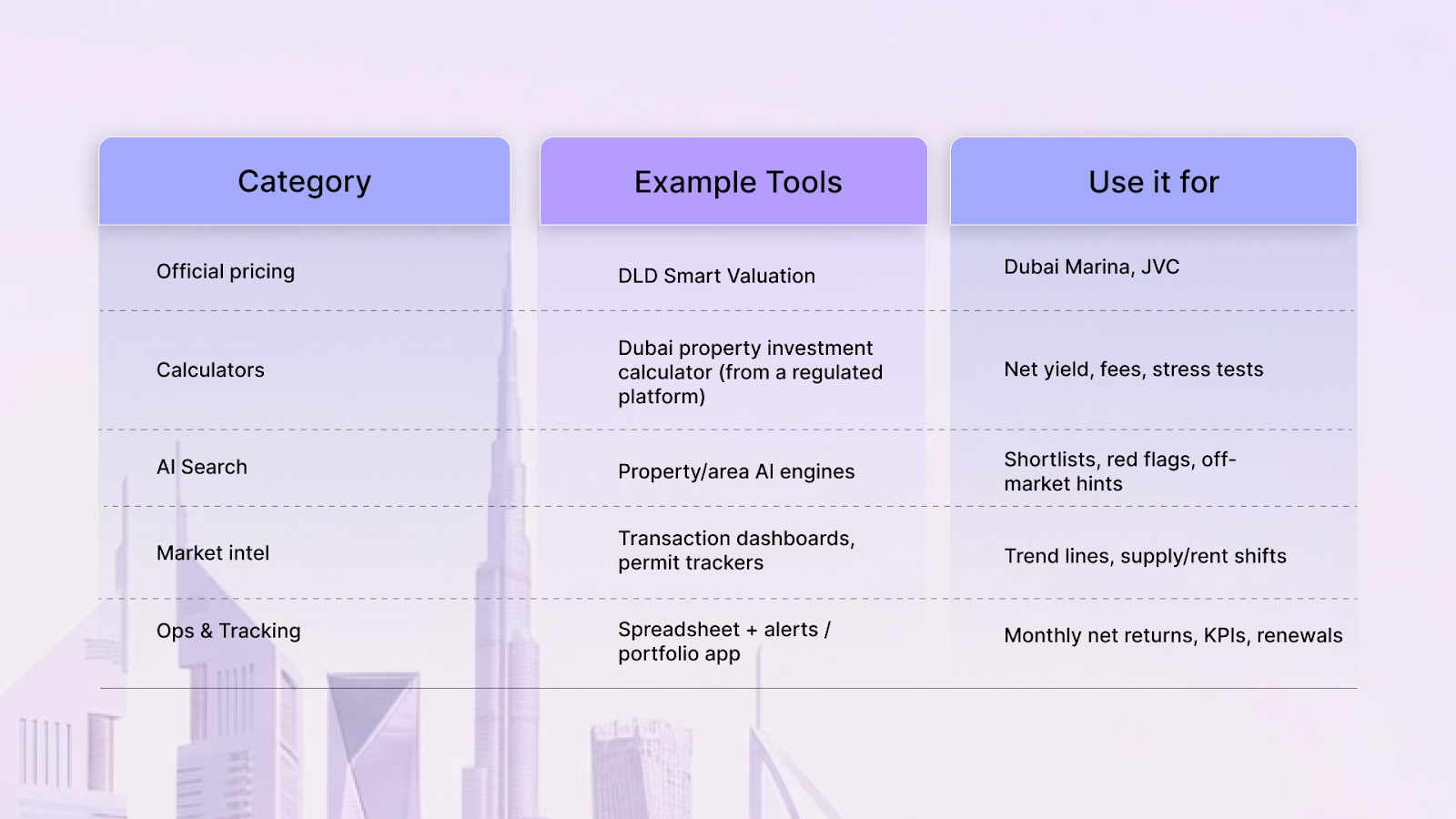
Mini Tool Stack (at a glance)
Pro tips (that save time and money)
- Always model net, not gross. Service charges, management, and vacancy trim 1–2 percentage points off yield—plan for that.
- Trust, then verify. If the net yield seems too high for the area, check service charge history and vacancy.
- Prefer clean liquidity. Buildings that rent fast will also resell faster in soft patches.
- Document everything. A tidy audit trail makes refinancing, resale, and tax filings smoother.
Common mistakes (and easy fixes)
- Mistake: Using last year’s rent to set this year’s price.
Fix: Pull current comps and renewal caps before you renew.
- Mistake: Ignoring district cooling and special assessments.
Fix: Ask for full utility statements and any planned capex.
- Mistake: Chasing headline yields with high service charges.
Fix: Compare net yield after all recurring costs.
- Mistake: One-and-done analysis.
Fix: Refresh your area scorecard every quarter; markets move.
Bottom line
Start with official data, add an AI layer for speed, and lock it all down with clear models and checklists. Do this and you’ll go from guesswork to a repeatable process—so your Dubai property picks can compound net income month after month.
Data/Original Insight Box
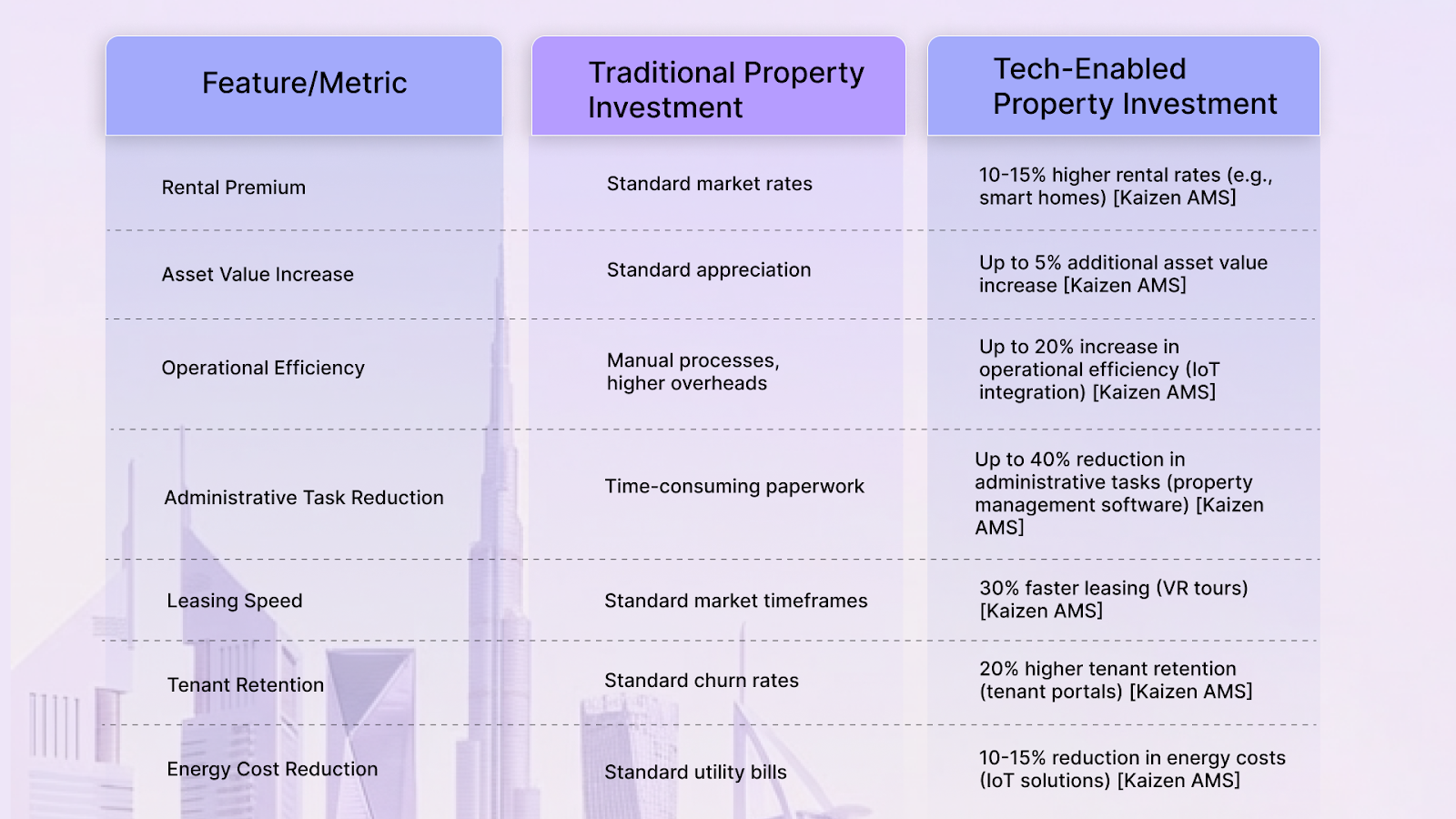
The Tangible Returns: Tech-Enabled Properties vs. Traditional Investments
Integrating technology into Dubai property investments is not merely a trend; it translates into quantifiable financial benefits. Our analysis, drawing from market data and industry reports, highlights the significant uplift in returns and operational efficiency for tech-enabled properties compared to their traditional counterparts. This insight underscores the strategic advantage gained by leveraging PropTech solutions.
This data clearly illustrates that while initial investments in technology might be required, the long-term benefits in terms of increased revenue, reduced costs, and enhanced property appeal far outweigh the outlay. For investors in Dubai, embracing these technological advancements is a clear path to optimizing their portfolios and achieving superior returns.
FAQ Section
Q1: What is PropTech and how is it changing Dubai real estate?
PropTech, or Property Technology, refers to the application of digital innovations like AI, VR, blockchain, and IoT to real estate. In Dubai, PropTech is revolutionizing property viewing with virtual tours, enhancing transaction transparency through blockchain, and optimizing property management with smart home solutions. It makes investing more accessible, secure, and efficient, attracting a new generation of tech-savvy investors and driving market growth.
Q2: How can AI help me find the best property investment in Dubai?
AI leverages vast datasets to analyze market trends, predict property values, and forecast rental yields. It can identify emerging investment hotspots, assess risks, and even personalize property recommendations based on your specific criteria. AI-powered tools provide predictive insights, helping you make data-driven decisions and optimize your investment strategy for maximum returns in Dubai's dynamic market.
Q3: Is it safe to invest in Dubai real estate using cryptocurrency?
Yes, Dubai has been a pioneer in embracing blockchain technology for real estate transactions, making crypto-based investments increasingly secure and transparent. The Dubai Land Department (DLD) has implemented blockchain systems for property dealings, minimizing fraud and streamlining processes. While due diligence is always essential, Dubai's regulatory environment and technological infrastructure support safe and efficient cryptocurrency transactions in real estate.
Q4: What are the benefits of smart homes for investors?
Smart homes offer significant benefits for investors, including higher rental premiums (10-15% increase), enhanced asset value (up to 5% appreciation), and improved tenant retention. Features like automated climate control, smart security, and energy monitoring attract discerning tenants and reduce operational costs. These technologies contribute to a more efficient, desirable, and profitable investment, aligning with Dubai's vision for sustainable and technologically advanced living.
Q5: Where can I find reliable data on Dubai's property market?
Reliable data for Dubai's property market can be found from official sources like the Dubai Land Department (DLD), which provides transaction volumes and price indices. Reputable market intelligence platforms such as Property Monitor and Statista offer detailed reports, trends, and forecasts. These resources provide crucial insights into market performance, growth areas, and investment opportunities, enabling investors to make informed decisions based on credible, up-to-date information.
Q6: How does Dubai's government support technology in real estate?
Dubai's government actively supports technology in real estate through initiatives like the Dubai Land Department's (DLD) VR Real Estate Platform and its early adoption of blockchain for property transactions. They also mandate eco-friendly construction standards and promote smart city initiatives. This proactive governmental support fosters an environment conducive to technological innovation, attracting PropTech companies and ensuring a secure, transparent, and efficient real estate ecosystem for investors.
Q7: What are the future trends for technology in Dubai property investment?
Future trends in Dubai property investment will likely see further integration of AI for hyper-personalized investment advice, expanded use of blockchain for fractional ownership and tokenization, and advanced IoT solutions for predictive building management. Sustainable PropTech, focusing on energy efficiency and green building, will also gain prominence. These advancements will continue to enhance market transparency, accessibility, and efficiency, solidifying Dubai's position as a global leader in tech-driven real estate investment.
DEED's Take
At Deed, we believe that technology should democratize access to sophisticated real estate investment tools, not complicate the investment process. Our platform represents the perfect balance between cutting-edge technology and user-friendly design, making advanced analytics accessible to investors regardless of their technical expertise.
We've integrated AI-powered market analysis with human expertise to create a platform that delivers institutional-grade insights through an intuitive interface. Our technology continuously monitors market conditions, analyzes property performance, and identifies opportunities that align with your investment goals.
What sets our approach apart is the combination of comprehensive data analysis with practical implementation support. While other platforms might provide data, we focus on actionable insights that directly improve your investment outcomes. Our AI systems don't just analyze properties—they help you understand why certain investments make sense and how to optimize your portfolio for maximum returns.
How DEED Leverages Technology for Better Outcomes
Our platform processes millions of data points daily to identify the most attractive investment opportunities in Dubai's market. We use predictive analytics to forecast property performance, helping you invest in areas before they become widely recognized as high-potential markets.
The technology behind our platform includes automated property screening, risk assessment algorithms, and portfolio optimization tools that work together to improve your investment outcomes. We handle the complex analysis while you focus on making informed decisions based on clear, actionable recommendations.
With investment minimums starting at just AED 500, our technology makes sophisticated real estate investment accessible to a broader range of investors. This democratization of access, combined with professional-grade analytics, helps level the playing field between individual and institutional investors.
Conclusion
In conclusion, the era of traditional property investment in Dubai is rapidly evolving. To truly thrive in this dynamic market, investors must embrace the transformative power of technology and data. From leveraging advanced analytics for predictive insights to utilizing virtual reality for immersive property exploration, and from securing transactions with blockchain to enhancing property value with smart home integrations, technology offers an unparalleled toolkit for smarter decision-making. The strategic adoption of these innovations not only optimizes returns and mitigates risks but also aligns investments with Dubai's forward-thinking vision. Don't be left behind in this technological revolution. Explore how these cutting-edge solutions can elevate your investment strategy. Contact a trusted PropTech advisor or real estate expert today to begin your journey towards smarter, data-driven Dubai property investments.
References
- [DLD] Dubai Land Department. (n.d.). Residential Properties Price Index (RPPI). Retrieved from https://dubailand.gov.ae/en/open-data/residential-properties-price-index-rppi/
- [Statista] Statista. (2025). Real Estate - United Arab Emirates | Market Forecast. Retrieved from https://www.statista.com/outlook/fmo/real-estate/united-arab-emirates
- [Kaizen AMS] Kaizen Asset Management Services. (n.d.). Analyzing the ROI of Tech Investments in Property Management for Dubai Real Estate. Retrieved from https://www.kaizenams.com/analyzing-the-roi-of-tech-investments-in-property-management-for-dubai-real-estate/
- [Property Monitor] Property Monitor. (2025). Monthly Market Report Archives. Retrieved from https://propertymonitor.com/insights/category/monthly-market-report
- [Range.ae] Range International Property Investments. (2024, June 26). Revolutionizing Real Estate in Dubai: How Technology is Shaping the Future. Retrieved from https://www.range.ae/medias/revolutionizing-real-estate-in-dubai-how-technology-is-shaping-the-future
- [Amazing Architecture] Hayes, A. (n.d.). The Impact of Modern Technology on Dubai Real Estate. Retrieved from https://amazingarchitecture.com/articles/the-impact-of-modern-technology-on-dubai-real-estate
__________________________________________________
For promotional purposes only. Property and other details may vary. Capital at risk. Deed is regulated by the DFSA.
Senior Growth, Marketing & Brand Manager | Elevating Brand Equity & Fueling Sales Growth Across Fintech, Proptech.
Signup to our newsletter!
Stay ahead with exclusive updates, insights, and opportunities delivered straight to your inbox.
Frequently Asked Questions

Start earning passive income today
Join thousands of investors building wealth through fully-managed rental properties.